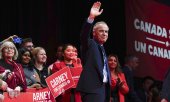
Canada's governing Liberal Party is the clear winner of Monday's federal election. Prime Minister Mark Carney's party overtook the Conservatives, securing an estimated 169 seats in parliament and falling just short of an absolute majority. Carney stressed his intention of strengthening his country's ties with "reliable allies" such as Europe. Commentators focus on the voters' motives.

Large-scale power outages plunged more than 60 million people in Spain, Portugal and parts of France into chaos on Monday. The internet and mobile phones went dead, traffic systems came to a halt, and homes and business were left without electricity. Although the power supply has been restored, the cause of the blackout remains unclear, but the grid operator has ruled out a cyberattack. Commentators draw their own conclusions.
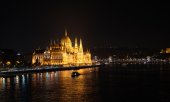
Under a new law, Hungarian MEPs will have to submit declarations of their assets in Hungary - as is already the case for members of the national parliament. However, while the latter are allowed to correct false or incomplete information retroactively, MEPs face the prospect of losing their seats in such cases. Opposition leader Péter Magyar claims that the law is aimed at him directly.

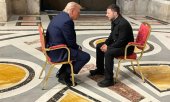
On the sidelines of Pope Francis's funeral, US President Donald Trump and his Ukrainian counterpart Volodymyr Zelensky met in St. Peter's Basilica on Saturday to discuss the war in Ukraine. While the White House described the meeting as "very productive", Zelensky said it had the potential to become historic. Commentators debate whether their talk could be a turning point.

The Stockholm International Peace Research Institute (Sipri) has calculated that global military expenditure increased by 9.4 percent in 2024, with that figure rising to 17 percent in Europe - including Russia - as a result of the war in Ukraine. Europe's 693 billion dollars of military spending includes salaries and weapons procurement as well as investments in research and development.