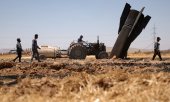
The Israeli air force repeatedly bombarded targets near the Syrian capital Damascus on the weekend. According to security sources, the attacks are meant to prevent missile deliveries to the Lebanese Hezbollah militia. Finally a country is standing up to the Syrian dictator, some commentators write approvingly. Others fear the attacks will only strengthen Assad and complicate a Western intervention.
With articles from the following publications:
Bild - Germany, ABC - Spain, De Morgen - Belgium
Bild - Germany
Contrary to the faint-hearted West, Israel is making a show of strength against Bashar al-Assad, the tabloid Bild writes in praise: "While the entire world looks on passively at the slaughtering in Syria (70,000 dead), a tiny country is drawing the line for the Syrian dictator. Israel is bombing targets in Damascus - making the West's vapid excuses look all the more shameful. For more than two years Western politicians have been maintaining that an intervention in Syria is too risky because the Syrian air force is too powerful. Israel has shown: the opposite is the case. Israeli fighter jets have now flown into the Syrian airspace at least three times - and returned from their missions unharmed. ... Unscrupulous murderers like Assad have nothing but contempt for soft diplomacy. Anyone who wants to draw a 'red line' for despots should book a course with Israeli Prime Minister Netanyahu." (06/05/2013)
The Israeli air strike against Syria helps Bashar al-Assad more than it helps the rebels, the conservative daily ABC fears: "In this case the intervention of the Israelis won't help to stop the bloodshed. Some will see it as an act of self-defence by the Israelis to ensure that Hezbollah's terrorist militia can't get hold of any heavy arms from Assad's regime - whatever the outcome of the Syrian civil war. But at the same time the bombardment will enormously complicate any Western intervention to help the rebels, and to a certain extent it will strengthen the dictator's position, at least among his followers. The regime's theory of connecting the rebels with Israel may not make much sense. But in the eyes of millions of Arabs, including the more moderate who favour democracy, this attack will sow confusion and lead to nothing good." (06/05/2013)
The attacks in Syria don't help Europe in its dilemma, the left-liberal daily De Morgen stresses: "The latest attacks have above all to do with Israel's own security. Israel's primary source of concern is the military transport routes between Iran and the Lebanese Hezbollah movement, which cross Syrian territory. ... Israel's activities have nothing to do with a broad-based, international response to Assad's atrocities. The whole thing is a solo show by and for Israel. It also changes nothing in the moral dilemma that Europe has been entangled in for the last months. Negotiations with Assad are out of the question, but too many atrocities have now been committed. It's too dangerous to arm the opposition, because that would also put weapons in the hands of extremist militias. Europe looks on and seems unable to do anything to stop the world's largest bloodbath." (06/05/2013)
The ECB brought down its benchmark interest rate to a new record low of 0.5 percent on Thursday. The central bank's head Mario Draghi justified the step as a measure against the persistent recession in crisis-hit countries. If they stick to the reform programmes the cheap money will help their economies recover, some commentators write in praise. Others believe that even massive intervention by the central banks won't end the economic and financial crisis.
With articles from the following publications:
ABC - Spain, Le Soir - Belgium, Frankfurter Allgemeine Zeitung - Germany, Hospodářské noviny - Czech Republic
ABC - Spain
The ECB's decision to lower the interest rate can help Europe's economy out of the crisis, the conservative daily ABC comments optimistically: "Making borrowing cheaper and giving the banks unlimited access to liquidity will help to fight the recession in Europe, benefiting all the countries in the monetary union, even the stronger ones. However all this won't make much of a difference if the governments don't continue the austerity and reform programmes for getting their economies back on track, as Draghi quite rightly pointed out. In the case of Spain, the measures adopted by the ECB will help the credit institutes to gain access to financing, which together with the government's bank reforms will help to reopen the credit tap for families and companies. After years of drought this will be a key factor in boosting investment and by extension growth." (03/05/2013)
The lowering of the base interest rate was overdue, writes the liberal daily Le Soir, which nevertheless feels the ECB should have had the courage to take even more radical steps: "The decision taken by the ECB on Thursday is doubly pleasing. First of all because the bank in Frankfurt has demonstrated its independence: despite pressure from the Bundesbank and voices in Germany that spoke out in favour of maintaining the status quo or even raising interest rates, the ECB decided to do the opposite. The other positive thing is that the ECB has understood that in matters of monetary policy one must speak out loudly - and correctly. ... But just because it's annoyed with Greece, why must Europe contradict the Olympic motto (higher, faster, further)? Why must it always do too little, too slowly and too late? In the US, a country that has resumed growth and scored points against unemployment, the Federal Reserve long ago lowered the key rate to zero." (03/05/2013)
Even the lowest interest rate of all times won't help, the conservative daily Frankfurter Allgemeine Zeitung comments, pointing to experiences outside the Eurozone: "Even benchmark interest rates of almost zero percent and large-scale purchases of government bonds in the US, the UK and Japan have so far done little to revive their economies. The expansive monetary policy is not having much of an impact because banks and financial markets are performing poorly and many companies and consumers are not so optimistic about the future. In such a situation applying the non-selective 'watering-can principle' in monetary policy doesn't help. ... The balance sheets of many banks with a generally good outlook in Southern Europe and elsewhere need fresh capital resources. Moreover it must be possible to close down banks that lack a sound business model. This is a job for the government, not the ECB." (03/05/2013)
Making money cheaper won't do anything to address the causes of the crisis, writes the business paper Hospodářské noviny on the latest decision of the ECB: "When the ECB brought itself to lower the base interest ten months ago, it didn't fundamentally improve the situation in Europe. Certainly, cheap money is pleasant to have in times of crisis. Less pleasant, however, is the fact that cheap money was one of the causes of the crisis in the first place. ... The central banks - the ECB as well as the American Fed and the Japanese BoJ - were able to stabilise the financial system with the money press. But then a new bubble started growing. Certain questions remain unanswered: how is this money to reach the people, how can industrial performance be improved, how can the level of employment - and with it demand - be raised, and finally, how can the confidence in an economically bright future for the industrial countries be renewed? These questions are far from being answered." (03/05/2013)
Italy's new Prime Minister Enrico Letta and France's President François Hollande advocated a stronger growth policy for Europe on Wednesday in Paris. At a meeting in Berlin prior to that, Letta and German Chancellor Angela Merkel had stressed that they would hold to the austerity course. Some commentators see the opinion spreading in Europe that austerity without growth impulses is the wrong way to go. Others warn against departing from a pure austerity policy.
With articles from the following publications:
Cinco Días - Spain, Der Standard - Austria, Il Sole 24 Ore - Italy
Cinco Días - Spain
The demand for a moderate easing of austerity is gradually being echoed throughout Europe, the left-liberal business paper Cinco Días notes, commenting on the joint call of Letta and Hollande for growth stimulus measures: "A wind of change - or perhaps more aptly a light breeze of change - is blowing gently across Europe. The calls of the weaker Eurozone economies for a policy that stimulates growth is gradually and tentatively spreading in the heart of the continent. If a year ago as the freshly elected French prime minister, François Hollande pushed for an end to the austerity policy, today his discourse has taken on a more realistic tone. Following his meeting in Paris with the new Italian Prime Minister Enrico Letta, Hollande has once again called for a new economic stimulus policy for Europe. But at the same time he also stressed the need to continue measures to correct the budget deficit." (02/05/2013)
Letta and Hollande stressed on Wednesday in Paris that economic stimulus measures should not be neglected in the bid to balance budgets. The left-liberal daily Der Standard warns the EU partners not to give in to the pressure to change course: "Countries like Italy and France that excel as critics of the belt-tightening measures have not exhausted their own possibilities by a long shot. On the contrary: last year the French government lowered the retirement age for people with long insurance periods - from 62 to 60. ... In Rome the new government is in the process of reversing the previous cabinet's reforms. If the EU partners were to support such mismanagement it would be tantamount to an act of negligence. Italy and France are just diverting attention from their own mistakes and inefficient political systems. Pinning all the blame for this on Angela Merkel is facile. When it comes to justified delays in debt reduction, Brussels has already shown its readiness to compromise. Further concessions are unnecessary." (02/05/2013)
Italy's new prime minister was wise to visit the main advocate of austerity policy, Angela Merkel, before anyone else, the liberal business paper Il Sole 24 Ore believes: "It's still too early to hope that Italy will regain credibility, particularly since the chancellor can hardly afford to deviate from the austerity course that is so important to her voters in her campaign for a third term in office. But between the lines of the orthodox principles and also in the convolutions of the European Stability Pact rules one can find the room for manoeuvre that were the reason for Letta's visit to Berlin. Precisely how much room for manoeuvre is not yet clear. But what is clear is that Italy must fight tooth and nail for its cause. ... Letta's mission in Berlin was a first step in this direction and a good start, because the new prime minister has spoken not just as an Italian but as a European. He didn't reject Merkel's arguments out of hand but simply tried to make Italy's motives, which are also shared by other EU states, understandable." (01/05/2013)
Italy's new prime minister Enrico Letta stressed during his first policy statement on Monday that his country needed measures that stimulate growth instead of just austerity policy. At the same he announced the scrapping of the property tax and institutional reforms. Some commentators believe that by vetoing the rigid austerity course Letta can be the trailblazer for the crisis-hit countries. Others say the opposition from Berlin and Brussels won't allow this.
With articles from the following publications:
Jyllands-Posten - Denmark, La Stampa - Italy, Diário de Notícias - Portugal
Jyllands-Posten - Denmark
The grand coalition in Italy brings together the social democratic PD and the conservative PdL of ex-prime minister Silvio Berlusconi, as well as the centrist Scelta Civica led by former prime minister Monti. An explosive combination not just for Italy's domestic policy, the liberal business daily Jyllands-Posten observes: "Letta must tread very carefully within his own coalition. ... On the one hand there's the demand of the Left not to lead Italy out of the crisis with austerity alone. But he also has to deal with Berlusconi's promise to refund the property tax voters were forced to pay. ... Many things point to the course of treatment prescribed by Enrico Letta differing in one major point from Mario Monti's: Letta intends to stand up to Brussels and make sure that cuts and reforms are not the only weapons used against the crisis. ... However the EU Commission has made it abundantly clear that there can be no growth without a reduction in the level of debt. The latter is currently at 120 percent, and that is Italy's biggest problem right now. Letta must react to it." (30/04/2013)
In his policy statement Letta promised to combat the crisis afflicting the country by lowering taxes, among other measures. He is secretly hoping to ease the austerity policy, the liberal daily La Stampa suspects, adding that this hope may be dashed: "It seems out of the question that the European terms will be immediately renegotiated. Why should the new government receive concessions that were denied to the old one? The only hope is that as time passes it will become increasingly clear across the Eurozone that the austerity policy is not viable. But so far it's only in other northern European countries, for example the Netherlands, that there are signs of a departure from the austerity dogma - certainly not in Germany. The danger is that by autumn little to nothing will have changed in the EU's course. In the meantime Italy will have fiddled around with its budget without implementing any genuine reforms. With the result that Italy will be unable to comply with the deficit limit and will be left with no room for manoeuvre in the coming years." (30/04/2013)
After surviving the vote of confidence in the Italian parliament on Monday, Letta must now take the next hurdle on his visit to Berlin today, Tuesday, writes the liberal-conservative daily Diário de Notícias: "It's not surprising that the German capital is the first destination on the new Italian head of government's agenda. Because Berlin is where the bulk of European policy, and particularly the anti-crisis measures, is decided. … Letta wants to boost growth in his country. ... And he has also set himself the goal of ensuring that his country sees the first results of a series of economic, social and political reforms within 18 months. ... Italy is desperately seeking new strategies against the recession, and the most audacious ones need the EU's blessing. This is why he talks of room for manoeuvre. And this is what he will tell Merkel today - using the powers of persuasion of the Eurozone's third-largest economy. And if Italy is successful, the rest of Southern Europe can strive to follow its example." (30/04/2013)
Italy's new government has been in office since Sunday. Under Prime Minister Enrico Letta, the left-wing PD and the conservative PdL have formed the first grand coalition in Italy since 1947. Some commentators are confident that the alliance forged by Letta and President Giorgio Napolitano can end the political crisis in the country. Others believe the truce between Left and Right won't last for long.
With articles from the following publications:
Il Sole 24 Ore - Italy, Der Standard - Austria, El Mundo - Spain, Neue Zürcher Zeitung - Switzerland
Il Sole 24 Ore - Italy
The parliament must give the grand coalition its vote of confidence this Monday. The MPs are unlikely to reject the government that has been skilfully put together by President Napolitano, the liberal-conservative business paper Il Sole 24 Ore writes with satisfaction: "It may be a parliamentary government rather than a presidential one, but Letta's work clearly bears the president's signature. And that's a good thing, because the parliamentarians need to feel the pressure of that hint of presidentialism with which Napolitano threatened them upon his re-election. It's clear that Napolitano was behind the appointment of certain ministers - starting with the excellent idea of giving the Foreign Ministry portfolio to [former trade and Europe minister as well as European Commissioner for Consumer Policy] Emma Bonino. A government that is based on a political pact between the PD and PdL, with a Minister of Foreign Affairs who as a representative of the small and secular Partito Radicale stands above the logic of the grand coalition - that's a real coup." (29/04/2013)
The fact that Letta has largely steered clear of erstwhile top-ranking politicians in forming his cabinet could be the start of a sensational renewal, the left-liberal daily Der Standard writes in delight: "It was as if he'd been asked to square the circle. Two months after the elections that imposed on Italy a stalemate with three irreconcilable political blocs, Enrico Letta had the task of performing a miracle and building a functional government. An almost impossible task, which the 42-year-old has nevertheless accomplished with bravado. He brought together in his cabinet two opposing forces that didn't see each other as political opponents, but as enemies. ... But the real miracle that Letta has worked in this country beset by an eternal gerontocracy is a long overdue change of generations. His new government is by far the youngest in the country's history, and it has the highest number of women. To ensure that his cabinet will be able to make things happen, the prime minister selected as his ministers people from both camps who are willing to strike up a dialogue." (29/04/2013)
The ability to forge a broad coalition in a political crisis is exemplary and represents an opportunity for other states as well as Italy, the conservative daily El Mundo notes approvingly: "The agreement has a number of weaknesses but it's good news for the country and shows that if the will is there, a 'state pact' [or agreement between the opposing political camps] can be reached. Italian politics may have a bad reputation in Spain but every now and then it can set an example for other countries to follow. ... Despite the difficulties into which this government has been born - and the radical opposition announced by Grillo - Letta now has the chance to bring stability to a country that has been living in a state of transition ever since the troika pushed through Monti's appointment as prime minister back in November 2011." (29/04/2013)
Enrico Letta's grand coalition is not the proof of reconciliation it is being sold as and won't last very long, the liberal-conservative daily Neue Zürcher Zeitung believes: "It's still possible that after the stalemate in the February elections the political parties have only agreed on a truce to have time to arm themselves for fresh elections, possibly as soon as this autumn. A stringent government programme that is crucial for a creating a stable coalition government has yet to be worked out. And perhaps the new government has so many younger and female members simply because the different camps weren't really committed to it. ... The fact that the Economic and Finance Ministries as well as the Ministry of Justice have been given to long-serving technocrats rather than politicians points to this government being less normal than Napolitano would have us believe." (29/04/2013)