
Iran and US: can talks prevent war?
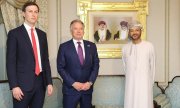
Negotiators from the US and Iran held indirect talks in Oman on Friday. Both sides lauded the start of negotiations, but at the same time upped the pressure: US President Donald Trump threatened to impose additional punitive tariffs on countries that do trade with Iran, while Iranian Foreign Minister Abbas Araghchi warned that attacks on his country would be met with attacks on US bases in the region.
A toxic environment
Politiken explains how difficult reaching an agreement will be given the various interests at stake in the region:
“Netanyahu's government in Israel is trying to manipulate Trump into a confrontation with Iran - if for no other reason than to avoid US demands for an end to Israel's untenable occupation of the Gaza Strip and the West Bank. Saudi Arabia and other Gulf states are playing a similar double game. Officially, they warn against a war with Iran so as not to be drawn into the maelstrom of war. In reality, they're counting on the US and Israel to thwart Iran's attempts to undermine the Arab world, even though the Arab governments themselves should be solving the problem.”
Regime change is a slogan, not a plan
Euripides L. Evriviades, former Cypriot ambassador to the US and Britain, warns in the Cyprus Mail:
“The most conspicuously unanswered question is the day after an attack on Iran. What follows a strike? What replaces the current order if it collapses? Regime change is a slogan, not a plan. Nuclear knowledge cannot be bombed away. Proxy networks do not disappear with command centres. Fragmentation creates vacuums that history shows are quickly filled, rarely benignly. The danger, therefore, is not simply escalation, but consequence without ownership. When the political end state is undefined, force risks becoming an act of demonstration rather than an instrument of strategy.”
Thwart the system with humanity
Political scientist Abbas Galliamov recommends on Facebook that the US exploit Iran's acute economic problems to push through political goals:
“If I were Trump, I would announce that in view of the dreadful situation in which millions of Iranian citizens find themselves, the Americans are committed to providing extensive humanitarian aid immediately as soon as a nuclear and missile deal have been concluded. ... The regime is trying its best to portray the West as the enemy, so a demonstratively peaceful humanitarian initiative would deal a severe blow to this discourse. ... The pressure on the system from the people would increase. ... Right now, any straw could be the straw that breaks the camel's back. But such a straw is needed.”
Trump doesn't care about the Iranian people
Le Soir discusses Trump's motives:
“Some experts believe that the US president could have his eye on Iran's gas and oil reserves, as he did in Venezuela a few weeks ago. There are numerous parallels between the two situations. For now, it's impossible to predict the outcome of these talks, which have only just begun. ... But one thing is certain, even if it doesn't suit US Secretary of State Marco Rubio: the fate of the Iranian people has once again fallen to the bottom of the US president's list of priorities. This is because he has no problem coming to terms with repressive regimes as long as they serve his interests.”
Birth of a new Middle East
The tectonics in the Middle East are shifting, writes Expresso:
“It seems clear that the regional bipolarity that has existed since 1979 between Washington, its regional allies and the Iranian bloc is coming to an end. In the coming years, we will see the interests of Turkey, Saudi Arabia, the United Arab Emirates and Qatar diverge in an environment of greater multipolarity and regional competition in which Washington's role than will be different to what it has been in recent decades.”