
EU summit: what does Europe's economy need?
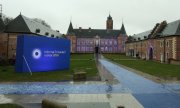
Setting the right course for Europe's economic recovery is the goal of today's informal EU summit at Alden Biesen Castle in Belgium. The governments in Berlin and Rome have presented a joint policy paper on the topic, but in an interview French President Emmanuel Macron voiced very different ideas. Europe's press discusses what the EU needs now.
Catch up, adopt guidelines
Important decisions must now be made, urges La Libre Belgique:
“Deregulation is urgently needed, while preserving the harmonisation of the single market. We don't need less Europe, we need a better Europe. A true single market that also encompasses energy, capital and innovation. ... The time for diagnosis is over. The delays (particularly as regards AI), the flaws and the challenges are well known. Now the heads of state and government must provide the political impetus so that the strategic guidelines can be adopted at the formal summit in March.”
Franco-German engine is stalling
The rocky relations between Paris and Berlin are slowing down the entire community, De Volkskrant complains:
“The Franco-German engine that could pull the EU out of the crisis has stalled. The two countries are at odds on almost all key economic issues. Macron preaches the protection of European companies and 'Buy European', while Merz sees this as a last resort. Berlin wants trade agreements, Paris votes against them. France wants more European loans (Eurobonds), Germany rejects this and advocates reforms. Merz wants the environmental requirements for companies to be more flexible, France is sticking to the Paris Climate Agreement.”
Rome and Berlin dividing the EU
The German-Italian initiative to transfer more powers back to the member states could divide Europe, La Repubblica warns:
“The Italian-German initiative ahead of today's informal EU summit is leading less to a reform of the balance of power within the bloc than to a backlash from the 'most European' front and from those who fear Russia's military threat the most - a group of member states that are particularly concerned about the possibility of a reversal of European integration towards nationalism. It's no mere coincidence that Macron, Spain's Sánchez, several Eastern European countries and the President of the European Council, Portugal's António Costa, are reacting with increasing annoyance to the Rome-Berlin tack.”
Size is not everything
Europe must bolster its internal market, but without depriving small countries of their individual strengths, De Standaard stresses:
“This fragmentation is not always nonsensical. Especially for small countries like Belgium, increasing the scale at the European level has considerable consequences. ... It's true that Europe can do more to expand its internal market. However size is only an advantage, not a necessity, for achieving outstanding economic performance. Countries such as Switzerland, Israel and New Zealand are proof of this. And yes, perhaps Prime Minister Bart De Wever's suggestion that we look to Singapore is not so absurd after all.”
Politicians who don't know how to communicate
Political scientist Dominykas Kaminskas calls in IQ for more frank communication:
“The sterile rhetoric of European leaders is worse than Trump's blunt impertinence. Even if Trump often talks nonsense, at least it's clear that he's speaking as a human being. ... European politicians want to appear respectable and are very guarded in the way they express themselves. This works as long as the political situation is stable, because if you say nothing, you give your opponents no opportunity to take offence. But in today's chaos, neither Ursula von der Leyen, Mette Frederiksen nor Friedrich Merz can convince people that they're speaking from the heart.”