
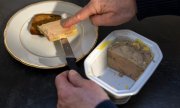
Ban debate: Swiss divided over foie gras?
Following a heated debate, the Swiss Parliament has rejected an initiative submitted by animal rights activists for a ban on imports of foie gras and voted instead for labelling declaring painful procedures performed on animals. Production of foie gras, a traditional French speciality, is already banned in Switzerland. Commentators explain why the debate has been so heated.
As if our future depended on it
The NZZ is astonished by the ardent rhetoric politicians are bringing to the debate:
“Anyone who thinks the term foie gras provokes strong reactions only among committed animal rights activists is mistaken. At least in the Swiss parliament, politicians associate it with their views of themselves and the world. ... Speakers have repeatedly pointed out that the initiative could jeopardise not only Swiss cohesion, but also the bilateral approach. ... In its message on the initiative, the Federal Council writes that import bans constitute 'serious infringements on free trade' and would violate agreements with the EU. Trade disputes are to be expected. ... By the looks of things there is hardly a single issue that is not connected to foie gras.”
An important culinary tradition
France must be seen as a culinary benchmark in this debate, 24 heures observes:
“It's an understatement to say that we in Switzerland are influenced by our neighbours when it comes to what ends up on our plates. For us French-speaking Swiss, this is the France whose 'gastronomic meal' has been listed as a Unesco intangible cultural heritage since 2010. This includes foie gras, which traditionally graces festive tables. ... France is a country where traditions are deeply rooted in the regions. ... Understanding this French reality is essential to grasping the Francophone Swiss people's attachment to regional products. … Today, we French-speaking Swiss can only hope that the majority in German-speaking Switzerland won't force us to drive to France every time we want to enjoy foie gras.”
Two different perceptions of Switzerland
This is more than just a food dispute, Le Temps puts in:
“Essentially, this debate acts as a mirror: it not only says something about what we have on our plates, but also about our relationship with freedom, responsibility and our own contradictions. Must we remain consistent to the very end, even if that means a ban? Or should we accept a certain degree of inconsistency in the name of individual freedom and cultural pluralism? The National Council has avoided a ban, but it has not bridged the divide. Because, in essence, the debate is taking place not only in our kitchens, but between two perceptions of Switzerland that are likely to remain starkly opposed long after these debates have ended.”