
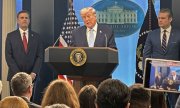
What will Trump's ultimatum achieve?
Trump has issued the Iranian leadership with an ultimatum, saying that unless the Strait of Hormuz is reopened by Tuesday night, power stations and bridges across Iran will be destroyed. Israel has also warned the Iranians on X to keep away from trains and railway stations. The UN is calling for a ceasefire and warning against violations of international law. Alarm bells are ringing in Europe's press.
The pirate capitalises on chaos
La Stampa compares this with past US interventions:
“Many people are rightly saying that 'Iran is not Iraq', but no one is bringing in the other half of the argument: that today's America is not the America of yesteryear. Trump has made this official with his usual brutality: 'We're taking the oil in Iran'. ... In other words: where America was the long-serving policeman in the old world order, in the new global chaos it is all set to become the pirate. The pirate does not fight the chaos, but capitalises on it. From this perspective, the events in Iran no longer look like a series of mistakes but are developing their own cynical logic.”
End of conflict still possible
Both sides would benefit from a deal, observes economist Bruno Colmant in Trends-Tendances:
“A gradual lifting of the sanctions in return for increased international monitoring of the nuclear programme and a calibrated international opening of trade: this approach is direct, transactional and almost Trumpian in its pragmatism. Tehran would not lose face, and would gain both time and economic breathing space. ... The US, under a Trump administration which never made a secret of its aversion to endless wars, would see this as a tangible success: stabilisation of the energy markets, a reduction of geopolitical risks and above all, victory without boots on the ground.”
The poorest and weakest suffer most
Beyond its impact on fossil fuel supplies, the war is also leading to fertiliser shortages and the destruction of desalination plants, warns Dagens Nyheter:
“If this means that harvests are smaller this year, it could bring hunger and death by starvation. It is an ancient truth that the people pay for the mistakes of the ruler. The price for the US having a president who is driven by his moods and narcissism in equal parts may be spread across the whole world, but the lion's share will be shouldered by the poorest and most vulnerable - in Iran, and in Lebanon, as well as in southern Africa.”
Fuel shortages yet to hit home
Relative normality is still in place, but that is about to change, predicts Latvijas Avīze:
“Oil tankers and liquid gas carriers that set sail before the outbreak of war on 28 February are still reaching the ports of the US, Europe and Asia. ... These ships move slowly, at a speed of about 12 nautical miles an hour, which is the equivalent of about 22km/h. ... Our sense of the crisis is currently caused by anxiety about the future, not by a real shortage of fuel or other commodities. In the coming days, however, this feeling will be replaced by very real, tangible shortages.”