
Nato crisis: can the alliance survive?
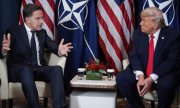
A meeting between US President Donald Trump and Nato Secretary-General Mark Rutte on Wednesday has failed to mend the rifts within the alliance. Rutte said afterwards that Trump was "clearly disappointed" by the Europeans' refusal to support the US in the war against Iran, while Trump pointedly raised the subject of Greenland again.
Withdrawal of US troops as political cudgel
La Repubblica comments on the White House's alleged plans to relocate US troops stationed in Europe to other locations:
“The decision would have serious consequences both for defence and economic policy. Potentially a real shock. Not to mention the fact that the selection of which troops to redeploy would be based on purely political criteria: countries that are regarded as 'friends' or as 'foes'. That would leave any country which is not looked upon favourably by the tycoon without troops. Yesterday's visit of Nato Secretary-General Mark Rutte in Washington thus takes on a whole new relevance. The head of the organisation did his utmost to defuse the dispute between the two sides of the Atlantic.”
Paying the price for Trump's threat tactics
Ukrainskyi Tyzhden blames Trump for the Nato crisis:
“The war with Iran has confirmed in practice what Trump's rhetoric has been making clear for some time: that the supposed unity of the Western world is an illusion. The 'collective West' did not come to the adventurer's aid, and demonstratively sabotaged measures that would have cost practically nothing [overflight rights for US aircraft]. ... Trump should not have been so arrogant, first threatening Denmark, then Canada. He should not have played around with tariffs, he should not have threatened to withdraw from Nato, and ultimately he should not have presented those on whose support he was counting with a fait accompli – only to play the offended party afterwards.”
Rutte driving another wedge into the alliance
With his attempts to get Trump on side, the Nato secretary-general has worsened the devides withing the alliance, De Standard criticises:
“He again snubbed members of the alliance by defending the attack on Iran and even going along with Trump's complaints. ... His promise that Nato 'can help' to open the Strait of Hormuz overlooks the whole point of the alliance, which is to protect the territory of its allies against hostile attacks. The organisation's charter is crystal clear on this point. Non-defensive force is permitted only within the framework of a UN resolution.”
How dependable are the Europeans?
Echo24 doubts that the principle of mutual defence will actually work within the alliance:
“Nato's strength was always the agreement that an attack on one member would trigger a war against all. Without this, the North Atlantic treaty is just a piece of paper. If Trump were to bluntly state that he will not be actively defending his allies, that would be the end of Nato, without the US having to formally leave. In Trump's case, however, there is no doubt whatsoever that he would honour his commitments. But would Spain seriously fight for Estonia? And what about France? Would Andrej Babiš order troops to mobilise for Tallinn? Perhaps it's better not to ask this question, because an honest answer could be the end of Nato.”
All the more crucial that Ukraine joins
In Lidové noviny, commentator Jaroslav Veis makes a strong case for Ukraine's accession to Nato:
“Trump is increasingly threatening to withdraw the US from the alliance. I wouldn't bet that he's just talking nonsense as usual, and that it won't actually happen. ... I hope the remaining Nato members find a way to admit Ukraine – a country with an army that is not only the most experienced in Europe but also the best equipped for future wars – to the alliance as soon as possible. EU accession can come later. Just as it was for us, by the way.”