
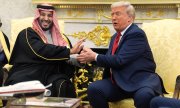
The US and the Saudis: implications of the nuclear deal?
The US and Saudi Arabia have signed a deal that will allow the Gulf kingdom to establish a civilian nuclear programme. The agreement is to form the foundation of a partnership under which the US exports nuclear technology worth several billion dollars to Riyadh. According to US Energy Secretary Chris Wright, the deal will also enforce nuclear nonproliferation. Commentators are concerned that it will put the Saudis on the path to developing a nuclear weapon.
Explosive potential
The deal could accelerate a nuclear arms race in the Middle East, warns The Financial Times:
“The US president may have wanted to seal a Saudi pact as a way of repairing relations damaged by his Iran war. But since Saudi Crown Prince Mohammed bin Salman has been open that if Iran developed a nuclear bomb the kingdom would follow suit, the regional proliferation dangers a poorly negotiated deal could eventually pose are clear. After the expiry of the last remaining major US-Russia arms control treaty and worries over the shrinking US nuclear 'umbrella', this would be a significant further blow to the non-proliferation regime.”
Protect security guarantees
De Volkskrant is concerned that Saudi Arabia is not subject to the strict standards of the International Atomic Energy Agency:
“The agreement appears to be a somewhat ill-conceived move that unnecessarily undermines the Non-Proliferation Treaty and is aimed, above all, at securing multi-billion deals for the American nuclear industry. ... The Saudi Crown Prince has made it clear that, should Iran acquire a nuclear weapon, his country will develop its own. The same debates are emerging in East Asia and Europe among US allies who doubt the binding nature of the US security guarantee. It is even more critical now, when the Non-Proliferation Treaty is under threat of being undermined worldwide, that there is no erosion of existing restrictions.”
Trust is out the window
Trump is playing with fire, warns The Daily Telegraph:
“What the new deal boils down to is simple: can we trust the Saudis? After all, this is a regime that: allegedly ordered the gruesome murder of dissident journalist Jamal Khashoggi in 2018, often coordinated oil production policy with Moscow and deepened ties with China, held human rights in little esteem in its own country (with executions, restrictions on freedoms and the routine mistreatment of women migrant workers), helped blunt Western sanctions on Russia. ... In other words, the answer to the trust question is surely no. If the Saudis want the capacity to produce nuclear energy, let them do so without giving them enrichment facilities.”
Echoes of the past
The Kurier points to an unlearned lesson:
“In 1967, just twelve years before the last Shah fled into exile ahead of the Islamic Revolution, the US provided the University of Tehran with a small nuclear reactor for research purposes. ... The rest is history: in 1979 the Islamic Revolution swept across Iran, the mullahs' regime seized power – and, along with it, the US technology that later became the foundation of Iran's nuclear programme. This anecdote is worth bearing in mind when considering the new nuclear agreement that the Trump administration signed with Saudi Arabia on Wednesday evening. For it is based on the same premise: handing over US nuclear technology to a Gulf monarchy in the quiet hope that the ally's rule will last forever.”
Better than with Russia or China
The Frankfurter Allgemeine Zeitung offers reassurance:
“The kingdom has been working for years to establish a civilian nuclear industry. ... Given this situation, it is better for the Saudi nuclear programme to be developed in partnership with the United States than with countries like Russia, China or Pakistan. If American companies build the necessary facilities, Washington will have a high degree of control over what happens there. The same goes for uranium enrichment ... . It would, however, be even better if control were more firmly in the hands of the International Atomic Energy Agency, as is customary in many other countries. The priorities of an American president can change – just look at Trump.”
Israel has lost its clout
In a Facebook post republished by NV, Middle East expert Ihor Semyvolos takes a critical look at Netanyahu's foreign policy strategy:
“As a result of the policies pursued by Netanyahu's government, the country has effectively lost its right of veto and its influence over the decisions of the US administration. This is largely due to Israel's refusal to accept Saudi Arabia's 2024 compromise peace plan (which contained only vague references to Palestinian statehood, without any clear timelines). ... The result: Israel has been left without any normalisation agreements; it faces a 'nuclear threshold state' in its neighbourhood; it has to accept the growing strength of Turkey and Qatar; and it stands completely alone in these negotiations.”