
What did US envoys achieve in Moscow and Kyiv?
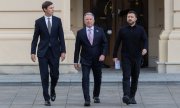
US envoys Steve Witkoff and Jared Kushner met with Russian President Vladimir Putin in Moscow and with Ukrainian President Volodomyr Zelensky in Kyiv on the weekend to discuss how to end the war between the two countries. Afterwards, Witkoff called on both sides to make compromises. Zelensky said that security and economic guarantees for Ukraine had been discussed. Moscow described the talks as "extremely frank" and "constructive".
Washington has embarassed itself again
The visit to Moscow on Saturday was a diplomatic faux pas, rants journalist Edward Lucas in Delfi:
“We should have been shocked by US Special Envoy Steve Witkoff's repugnant fawning over Putin. And also by the fact that Witkoff and his equally unimpressive sidekick, Donald Trump's son-in-law Jared Kushner, travelled in a convoy of Russian government vehicles and relied on an interpreter from the Kremlin during the Moscow meeting. Unfortunately, repugnant rhetoric and actions from Washington seem to have become the norm. ... Much like the US president's daily tirades on social media, unpleasant episodes only shock us until they are overshadowed by the next alarming piece of news.”
Time is on Putin’s side
Journalist and former deputy minister for infrastructure Mustafa Nayyem analyses the situation on Facebook:
“Donald Trump has made his ability to bring wars to a swift end an integral part of his political image. Furthermore, the political calendar is piling on the pressure: the mid-term elections are just around the corner and the presidential election campaign begins about a year from now. ... The more urgently Washington needs results, the more sense it makes for Moscow to play for time, continue the war and wait for the next offer. This is why I would focus less on the number of visits by Witkoff and instead ask what has changed in Putin's calculations after each of these visits. Right now the answer seems to be pretty clear: nothing.”
At least a functioning channel of communication
This diplomatic initiative must be taken seriously, political scientist Bernardo Ivo Cruz urges in Diário de Noticias:
“The EU and Kyiv's allies have made it clear: only Ukraine will decide the terms for ending the war. This means that we may have to accept a settlement that is acceptable to the Ukrainians but which results in tangible gains for Russia. An imperfect peace that would neither fully restore the justice violated by the aggression nor wholly uphold international law. ... Yet after four and a half years of war, the mere return of a diplomacy capable of engaging with both Moscow and Kyiv must be taken seriously.”
Too early for diplomacy
Diplomacy can only begin once Russia has lost, Le Point argues:
“At this stage there will be no diplomatic solution to this war. Some conflicts end around a negotiating table. But there are others where the negotiating table only comes into play once an imperialist regime has realised that it has lost. That was the case with Germany in 1945. And with Serbia in 1995. And it is exactly what will happen with Russia too: the diplomats will only get to work once the reality of the battlefield has, in one way or another, been acknowledged in the Kremlin's inner circles. Until then, the winter will be brutal, and we must help Ukraine to hold out.”
A small step in the right direction
Military expert Oleksiy Kopytko is optimistic in a Telegram post republished by Echo:
“There is no doubt that the path to genuine agreements will involve heavy-handed pressure. Right now it looks like the US is intent on exerting pressure primarily, or even exclusively, on Ukraine, because the country is heavily dependent on external support. With regard to Russia, only China could assume this role, but Beijing has yet to intervene. ... This round of negotiations will not lead to an immediate end to the war. That would take a miracle. ... But it is a small step in the right direction. I am confident that by winter serious attempts will be made to initiate genuine negotiations leading to a ceasefire.”
Putin’s final bid with Trump
So far Putin's hopes regarding Trump have been dashed, Gazeta Wyborcza concludes:
“Putin and his entourage had hoped that Trump would do for them the job they themselves are unable to do on the front line, and force the Ukrainians to hand over to the Russians what they demand but have been unable to secure despite heavy losses. ... That was their aim at the summit in Anchorage in August 2025, but it failed. ... Trump's shelf life is coming to an end. It looks as though his fellow Republicans will suffer a defeat in the mid-term elections on 3 November and his hands will be tied by a hostile Congress. ... So if the Kremlin can still get anything out of him, it has to be now.”
No hope without concessions by Zelensky
In a Telegram post republished by Echo, journalist Fyodor Krasheninnikov sees the Ukrainian president playing a key role:
“I am wholeheartedly in favour of ending the war as quickly as possible, but in September 2026 there is only one way this will be possible – namely, if Trump's envoys persuade Zelensky to accept Putin's humiliating and unjust terms. Should this prove impossible for Zelensky, talks is all there will be. To those who want to jump to conclusions about my stance and ask, 'Well what do you propose?' I say: I am not proposing anything. I am merely saying that the war will continue and there are no other options unless Zelensky is prepared to make concessions.”
Russia wants to eliminate the Ukrainian state
All Russia's demands call into question Ukraine's very existence, making concessions on Ukraine's part practically impossible, argues journalist Vitali Portnikov on TSN:
“Russia has a clear ambition: the elimination of Ukrainian statehood and the expulsion of a large part of the Ukrainian population from the territories in which they live. ... It will not seek a compromise with a nation whose statehood it seeks to eliminate. That is why, since 2014, there has been no alternative but to stand firm against it; there will be no other option in 2026, nor beyond that. ... What is at stake here is nothing less than the right of Ukraine and the Ukrainian people to an independent existence.”