
Protests in Europe: how to tackle the unrest?
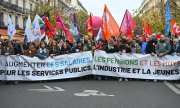
The youth protests that have erupted in several European countries in recent weeks are gaining momentum. French trade unions called a nationwide general strike on Thursday, with hundreds of thousands taking part in the demonstrations. Europe's press discusses solutions.
A generation that refuses to give up
The Times of Malta backs the protesters:
“They want to be taken seriously and to play a meaningful part in the world around them. Their vitality should inspire us, not frighten us. Told endlessly that the world is ending, they refuse to give up. Called individualistic, materialistic and glued to their phones, they gather shoulder to shoulder in solidarity. Their courage and determination are winning wider support. Teachers and families in Spain, France and Serbia have marched alongside students. In France, trade unions have joined them too. ... The least we can do is recognise the legitimacy of their anger and question our decisions. And do better.”
The president’s abject failure
The vast majority of French people who are not protesting are suffering twice over, Le Figaro laments:
“We must not become accustomed to these repeated remote-controlled processions. For behind the images of revolt, the real reasons for the protest remain hidden. At present there is no specific law at stake. ... Admittedly, the country is ailing. But another France – the silent majority – wants the chaos to end. It is being held hostage by those who are dragging it deeper and deeper into the abyss. It, too, could take to the streets to cry out in despair. This silent majority is paying the price for the ruinous policies of recent years. Emmanuel Macron was elected on the promise of uniting the French people. He has abandoned them to the architects of chaos.”
New strategic mindset needed
The root causes of the discontent must be addressed, says Maszol:
“The solution lies in changing the strategic mindset. Peace must be established [in Ukraine], the sanctions that are damaging the economy must be lifted, industry must be revitalised, affordable energy must be secured, the use of artificial intelligence must be restricted and regulated, and migration must be strictly monitored. ... European policy must not be made subordinate to geopolitical conflicts while the continent's own economic and social foundations are weakening. Above all, a predictable future must be created for young people – that is the central task.”
Demonstrators confusing the roles
LRT's Germany correspondent, Vytenė Banser, writes:
“The Gen Z protests that swept through Germany were, shall we say, not entirely unproblematic. ... From a Lithuanian perspective, I was particularly surprised by the anti-Nato placards alongside communist hammer-and-sickle symbols. In Hamburg, I even saw a banner bearing the slogan 'Russia is not our enemy'. This confuses the roles of victim and perpetrator. Clearly, these demonstrators are misjudging the geopolitical situation: with its war of aggression against Ukraine, Russia poses a threat to the whole of Europe. Without a strong Nato and a Bundeswehr ready to defend the country, Russia's bloody iron fist – or a Russian drone – could well turn up in Germany before today's Gen Z has even left the educational institutions they say are being so badly neglected.”
Criticism of military buildup should open our eyes
We need to take a page out of the demonstrators' book, says Huffpost Greece:
“Could it be that these young people, whom we have so greatly underestimated, have begun to talk about values – at a time when we older generations have so passively accepted their absence? How can we, who were brought up by people who lived through the Second World War, believe that a future shaped by the arms industry could be a good one? It's strange that in a united Europe which has spoken so much of humanism, the arms industry is suddenly being portrayed as an attractive prospect by some. In our country, for example, people have started asking how it can be that weapons designed to kill have suddenly become objects of admiration.”
Climate justice is the solution
France can emerge from the crisis by adopting an eco-minded approach, political scientist Théodore Tallent argues in Le Monde:
“The 21st-century welfare state views environmental protection as a policy designed to safeguard against climate risks, but also against the precarious circumstances of those whose daily lives depend on fossil fuels. Furthermore, it pre-empts crises rather than merely remedying them, by investing in the regions and supporting households as they adapt. It demands more from those who pollute the most, in order to support those who have no choice but who also have a right to a decarbonised world that will restore their purchasing power and freedom. Only in this way can the state tackle not only the social crisis, but also the democratic crisis marked by a collapse of trust.”