
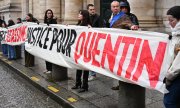
Escalating political violence in France?
With just a month to go before local elections in France, the death of a suspected right-wing extremist student has sent shock waves through the country. According to French prosecutors, Quentin D. was beaten by several attackers and sustained lethal injuries on 12 February in Lyon on the sidelines of a protest against Rima Hassan, MEP of the left-wing LFI. The French government holds the LFI-affiliated militant group Jeune Garde responsible for the attack.
Angst-filled atmosphere
The situation in France is highly explosive, Italy correspondent Eric Jozsef comments in La Stampa:
“Rarely has France been so fearful about an explosion of political violence. Over the past 15 years the country has faced several serious challenges, from Islamist attacks such as those at the Bataclan to riots in the suburbs and political assassinations. But society, the institutions, the political class and the citizens remained steadfast. There were no signs of revenge or retaliation. This time, however, the context has changed and the atmosphere is filled with fear. ... Against the backdrop of the upcoming presidential election [in 2027], French politics is on the brink of implosion and the situation is highly volatile.”
Where's the solidarity with victims of racism?
People are over-identifying with the victim on a questionable basis, the taz writes:
“We're seeing a Charlie Kirk effect here. President Emmanuel Macron assured Quentin D.'s family of nothing less than 'the support of the nation'. Wouldn't a condemnation of the violence have been enough? By way of comparison: ... On 31 May 2025, Tunisian hairdresser Hichem Miraoui was murdered by a Le Pen supporter who shot him five times. Racist police brutality has repeatedly led to deaths in France ... One could also mention the 164 femicides in 2025 alone. ... It's telling that political rhetoric does not promote anywhere near the same sense of 'us' when it comes to women and people with African names.”
Blind to their own fascism
In their campaign against Marine Le Pen and the right wing, France's leftists are overlooking how radicalised their own supporters have become, The Spectator explains:
“Many Socialists, like their friends in the media, have selective morals. While they are always ready to accuse Marine Le Pen's party of being a danger to democracy, they ignore the clear and present danger on the left. ... Much of the left in France believe they have the monopoly on morality. They also believe that anything goes when it comes to fighting 'fascists'. Their fanaticism blinds them to the reality: that they have become the fascists.”
The far right is distorting the facts
The far right wants to exploit the issue to its own advantage, warns Libération:
“[Far-right politician] Marion Maréchal Le Pen said that 'violence from the far right is insignificant compared to violence from the far left'. This is false. The interior minister can confirm this. And [RN chairman] Jordan Bardella distorted the facts at his press conference, claiming in particular that the Rassemblement National (RN) no longer has any links to fascist, identitarian, ultra-violent or racist groups. That, too, is false. ... The coming days and weeks will show whether the drama in Lyon tips the balance, which would clearly have a significant impact on the presidential elections. Nothing can be ruled out.”
De-escalation techniques as a school subject
Schools need to teach pupils how to avoid resorting to violence, advises Antoine Marie, an expert in political psychology, in The Conversation:
“De-escalation techniques such as refusing to react violently to provocations must be taught systematically. The history of the American civil rights movement shows that non-violence is not only morally superior, but also strategically more effective. This is true in particular because it gives social movements greater 'moral credibility' in the eyes of those who do not yet support them. ... Since radicalisation mechanisms are most common among (male) youths, this could be taught from secondary-school level, just as they have started to do with misinformation.”
Turning point before the elections
The incident will further divide France and push key election issues into the background, warns Les Echos:
“One month before the local elections, this event marks a turning point: extremism is killing people in France. The undeniable violence in the public debate and the polarisation driven by the extremes are one of the hallmarks of recent years. ... Security will play an increasingly central role, as in the local elections. This is certainly legitimate, but it will not be good for the economy. ... Given the immense challenges that must be addressed, the economic and budgetary plans of future candidates should not be relegated to the background.”
The country needs calm
Now is not the time to stir up more hatred, warns Libération:
“What is certain is that the unbearable climate of excess and intolerance that has pervaded French politics for some time now – and unfortunately not just French politics – can only lead to such tragedies by inflaming overly simplistic minds, whatever their political leanings. But those who are now pointing the finger at this or that culprit, further stoking the flames under this cauldron of simmering hatred, would do well to regain their calm and composure.... With just a month to go before municipal elections and just under a year before the presidential election, we must remember at every moment that political violence can lead to killings.”
Martyr of freedom of expression
Quentin is a victim of left-wing tyranny of opinion, Le Figaro concludes:
“The 'anti-fascist totalitarianism' predicted by [philosopher Alain] Finkielkraut has manifested itself in its most savage form in Lyon, but it has been hanging in the air like toxic conformity for far too long. ... An entire generation trained to dehumanise anything even remotely associated with the 'far right', politicians who go along with this out of cowardice, a media clergy that pronounces blanket condemnations, and a boy who peacefully wants to protect a banner against 'Islamo-Gauchisme in our universities' and dies under a barrage of blows. ... In this story Quentin is not an 'activist' caught up in a 'brawl', but a martyr of freedom of expression.”