
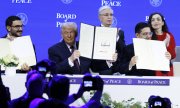
What can Trump's "Board of Peace" achieve?
The Board of Peace established by US President Donald Trump in January is scheduled to meet in Washington on Thursday to discuss the Gaza conflict. Trump has announced that its members have pledged around 4.2 billion euros for the reconstruction of the war-ravaged region and security forces. So far the board has 26 member states. Several countries plan to participate as observers.
Romania could be the go-between
With his observer role in Trump's Board of Peace, the Romanian president could become an important mediator, journalist Emilian Isaila points out in Spotmedia:
“President Nicușor Dan has taken a decision that offers a rare diplomatic opportunity to create an official channel of communication with the US leader. ... Romania's participation in the Board of Peace may in turn offer France and Germany the opportunity to convey messages to the US administration without exposing themselves to complicated political controversies at the domestic level. Romania has often played the role of messenger between the major powers in the past, which only strengthened the influence and credibility of the political leadership in Bucharest.”
Meloni at a loss?
La Repubblica disapproves of the course adopted by Italy, which also plans to act as an observer at the Board of Peace:
“The bridge function (between Italy and the US) is proving extremely unstable. Meloni's euphoric international agitating has earned her flattering praise, but not recognition of an effective and authoritative political leadership role. ... Italy seems incapable of playing an independent role, either in transatlantic relations or at the European level, and much less in the Russian-Ukrainian conflict or the ongoing Middle East conflict. Today the Prime Minister seems unexpectedly at a loss. Like someone who, after taking a deep breath and beginning a sweeping rhetorical construction, pauses mid-sentence because they can't find the right word.”
Historical allies kept at bay
Trump doesn't want Europe involved in the Board of Peace, La Stampa argues:
“Doubts about its effectiveness and influence on the multilateral system have prevented the vast majority of Western states from participating. Can a handful of countries succeed where universal organisations such as the UN and the OSCE have failed? This political and strategic reserve is a consequence of the transatlantic rift that opened up in the first year of the Trump administration and was confirmed at the Munich Security Conference. The American president doesn't want us at the negotiating tables on Ukraine and Iran. ... Trump's geopolitics are keeping 'historical' allies away from the Board of Peace – even London, which has never happened before.”