
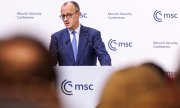
Merz's speech in Munich: new impetus for Europe?
Chancellor Friedrich Merz delivered a keynote speech at the start of the Munich Security Conference in which he emphasised that Europe must preserve its own values, actively protect its freedom and build on its strengths. "We must flip the switch in our minds," he said, outlining a sovereign Europe that breaks free from its excessive dependence on the US. Europe's media examine Merz's vision and point to potential flaws.
Historic – provided words follow deeds
Pavel Polák, former Berlin correspondent for Czech public radio and television, describes Merz's appearance on Český rozhlas as extraordinary:
“To hear the German Chancellor say that it is necessary to build a strong army, to pursue power politics and that the power of the US has passed its peak is truly remarkable for someone who has been following German politics for a long time. Merz's speech may thus go down in history – but on one condition: that he goes beyond announcements and begins to implement the programme for Europe. History, as we know, pays little attention to empty words and wishes.”
Two pillars for a strong Europe
It was Merz, not Marco Rubio, who made the most significant statements at the Munich Security Conference, Berlingske observes:
“The key speeches in Munich were those by the Europeans themselves. Federal Chancellor Friedrich Merz firmly rejected President Trump's view that the United States can achieve all its goals without friends and allies. ... In his powerful speech, Merz outlined a roadmap for Europe based on two strong pillars. The first is a significant strengthening of Europe's defence capabilities and an independent European wing within Nato, which now also includes nuclear defence. The second is the implementation of comprehensive economic reforms and the reduction of regulations and bureaucracy, anchored in new global partnerships.”
Notorious overregulation identified as key problem
Merz hit the nail on the head, essayist Henrique Raposo writes in Expresso:
“Merz points a finger at the regulatory ego of the EU and European democracies in general. Within six months, China has installed solar panels equivalent to the entire capacity of the United States or Europe. In the EU this project would be impossible, not least because it would be bogged down for years in studies and counter-studies by the regulatory bureaucracy. That is the problem with Europe and blue [partially Democrats-dominated] America: we've turned the 'liberal' project into a permanent blocking force, a reactionary force that is afraid of action and the future.”
Mutual dependencies
Merz has set a pragmatic course, says Maszol:
“Despite all the pomp and preparations, Europe knows that it is not ready to stand alone in the world, and the US needs the old continent's prestige and Europe's civilisational and international legitimacy. ... In any case, acceptance of mutual dependence is at the heart of the Munich Security Conference, and the camps have made conciliatory gestures towards each other. The German Chancellor has recognised that a new world order is emerging and has placed Europe in this order by saying: Not only does Europe need the US, but the US also needs Europe.”
Berlin leaving Europeans in the lurch
Le Figaro sees hard times ahead for the Franco-German friendship:
“At first, one might have believed this was due to a lack of personal chemistry between Emmanuel Macron and the former chancellor, Social Democrat Olaf Scholz. But with the Christian Democrat Friedrich Merz it has become clear that the problem goes deeper: the gap between the two countries is becoming dangerously wide and risks becoming irreconcilable. ... Germany is taking the typical German approach to rearming, i.e. massive. ... Most of the money is reserved for its national industry, with the rest going to arms dealers in the US and Israel. Not only are Europeans being left out, but joint Franco-German projects such as the aircraft (FCAS) and the tank of the future have come to a halt.”