
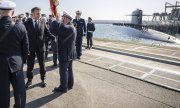
Macron outlines nuclear deterrence for Europe
France will focus on increasing its nuclear arsenal and use it to enhance Europe's collective security, President Emmanuel Macron stated in his speech on the update to the country's nuclear doctrine. He also mentioned the possibility of relocating French nuclear weapons to other European countries. Shortly after the speech, France and Germany issued a joint statement establishing a "steering group" for closer cooperation on deterrence.
Relying on protection from Paris is not enough
France's nuclear umbrella won't solve its neighbours' security problems, De Standaard warns:
“It will take far more to strengthen the European continent's resilience. We're talking about conventional weapons here. Cooperation in this area is obviously much more difficult than simply taking shelter under the French umbrella. The immense investments require far-reaching integration, otherwise the costs will only increase. Europe needs economies of scale and uniformity. All too often, European leaders fall back on initiatives in their own countries.”
Polish Trump fans putting their eggs in the US basket
Polish President Karol Nawrocki has said that his country should make greater efforts to participate in the US's Nuclear Sharing programme. Rzeczpospolita criticises the right wing for its fixation on America:
“Instead of an objective discussion we once again see a Pavlovian reflex on the right - a deal with the French could upset the US allies, so we'd better keep our mouths shut, even if we achieve nothing in Washington. ... You might think that the right wing would have learned its lesson from Donald Trump's unpredictability. But the initial reaction to the French proposal shows that this is not the case. The strategy of putting all your eggs in one basket, namely the American one, remains highly popular.”
Spread respect, not fear
Corriere del Ticino is sceptical:
“The issue of deterrence is highly sensitive, not least because it is based not only on arsenals but also on the perceived military might and conviction of individual powers. And this issue has become even more sensitive for Europe in view of Trump's ambiguity vis-à-vis his allies, Nato and a more comprehensive concept of defence. ... We can therefore understand Macron's strategic move, which is also motivated by domestic considerations in the run-up to next year's presidential election. Nevertheless, one questions whether the opposite path might not also have been an option: that of strengthened diplomacy, a clearer path towards peace, and seeking freedom through restored respect rather than fear.”
Rearmament promotes war, not peace
If Europe focuses on rearmament its diplomacy will stall, comments T24:
“If the number of nuclear warheads is increased, diplomacy will lose its status as a 'last resort' and become the first principle to be abandoned. ... Any preparation made in the name of security makes a new war a little more likely. History has shown time and again that sooner or later weapons developed with the promise of deterrence create a reason for their use. Today Europe believes it is protecting itself, but what it is actually losing is the claim that it opposes war. For any continent that takes up arms has long since swept peace off the table.”
Equipped for all scenarios
Macron's proposal makes sense to Jyllands-Posten:
“For decades, we were spared having to deal with the question of Europe's defence with nuclear weapons. But that time is over now. ... We should be prepared to contribute to what could, in a best-case scenario, be a strengthened European pillar within continued transatlantic cooperation – and, in the worst case, the first building block for our own common European nuclear infrastructure, should the US (contrary to expectations) decide to turn its back on its allies after all.”
The alternatives would be worse
The Financial Times praises Macron's offer:
“It is a significant step forward in Europe's efforts to take more responsibility for its own defence at a time when brute power takes over from co-operation and international law in shaping the global order, of which the US-Israeli attack on Iran is the latest reminder. ... Macron has recognised France's deterrent is indispensable for Europe's defence. The alternatives of an EU deterrent or national races for the bomb would be worse. Regrettably, Europeans can no longer complacently rely on the US to protect them at all cost.”
A boost for France
L'Opinion sees advantages for both France and the continent as a whole:
“Just as France no longer means much without Europe, the continent is no longer as well protected as it used to be without the American protective shield. It was therefore necessary to integrate a little Europe into the complex alchemy of deterrence - cooperation with our neighbours, but still under French control. ... For France, so often downgraded to the status of an over-indebted middle power, having (and retaining) this unrivalled and non-transferable power of nuclear fire is reassuring.”
Paris still the control centre
The taz's Paris correspondent Rudolf Balmer underlines that Macron is not about to relinquish control over France's warheads:
“Macron is giving the other EU countries only passive membership in the exclusive club of nuclear powers. This means that, in future, the French leader will continue to decide entirely on his own over deterrence and deployment. They could have a say in the expansion of the nuclear arsenal, joint exercises and manoeuvres, and - importantly - the potential deployment of nuclear weapons in other EU countries. So for the foreseeable future Europe will not become an independent nuclear power. And that is no doubt for the best.”