
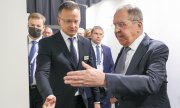
Hungary: Foreign Minister Szijjártó in tight corner?
According to a leaked audio recording published by investigative media, Hungarian Foreign Affairs Minister Péter Szijjártó promised his Russian counterpart, Sergey Lavrov, that he would do his utmost to have the sister of a Russian oligarch removed from the EU sanctions list. He also reportedly promised Russian Deputy Energy Minister Pavel Sorokin that he would work towards having the sanctions against the Russian shadow fleet lifted.
Budapest no longer in the team
The EU allies have already turned their backs on Hungary, concludes Válasz Online:
“It's not only the unconditional submission to Russian interests that is shocking, but also the message [conveyed by the leak of the intercepted phone call]. Our European partners have made it clear: as far as they are concerned, the current Hungarian leadership no longer belongs to the EU football team; it is playing for the other side. ... Hungarian citizens can, of course, still decide on 12 April to vote for the 'safe' option once again, but for our country this will most likely mean the end of life within the EU, with all the economic and social consequences that entails. De facto, of course, we will remain members, but we will be excluded from all important negotiations, and we can also write off the frozen EU funds for good.”
Moscow dictating the arguments
This is about representing Russian interests, argues Népszava:
“As has now come to light – and he has not denied this – Péter Szijjártó consults with the Russians even before sanctions are adopted so that the companies and individuals affected can move their assets to safety or quickly set up a network of companies to conceal their holdings before the decision is made. … Until now, Brussels was under the impression that the Orbán government was simply aligned with Russian interests, but increasingly signs are emerging that the arguments for Hungary's sovereign position are being dictated by Moscow.”
EU enablers equally to blame
Leading European politicians are equally to blame, Polityka points out:
“The revelations confirm that the EU has a Trojan horse in its midst and is struggling to combat the problem. ... Unfortunately this whole affair says just as much about the EU as it does about Orbán. For years the Hungarian prime minister stood under the protective umbrella of the European centre-right parties, defended by Angela Merkel and the leaders of European People's Party. And even when it became common knowledge in Brussels that he was collaborating with Moscow, the community was unable to solve the problem. So the question remains: what will the EU do if Orbán miraculously remains in power?”