
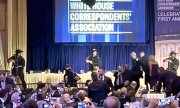
Washington: shooting at dinner attended by Trump
US President Donald Trump, his wife Melania Trump and several members of his administration had to be escorted to safety after shots were fired at the annual Correspondents' Dinner in Washington at the weekend. A 31-year-old man who was reportedly carrying a shotgun, a handgun and several knives has been arrested. Commentators examine the ramifications of the attack.
The President just fuels the tensions
The US president knows how to capitalise on every moment, no matter how unsettling, writes Visão:
“Another shooter, another incident in a series that, by all accounts, is not over yet – either during or after his time in the White House. There is a raw energy, a persistent fury directed at Trump. … Trump knows there is a bounty on his head, yet he stokes this tension, plays on it. And in the wake of this near-tragedy, his two responses are simple: he speeds up the construction of the ballroom in the White House – the most secure place in the world – and praises the Secret Service. All calculated. As always.”
Dark clouds gathering
Večernji list fears that if an assassination attempt on Trump were to succeed, it would start a civil war in the US:
“A single bullet would be enough to bring about a catastrophic change in the US – and thus the whole world. ... If one of the many madmen who have tried to kill Trump in recent years were to succeed, there would be serious global repercussions. America would become a very grim place overnight, and radicalisation would run rampant. It's like driving a tanker into a fire that has been burning for weeks in a nation that is already so bitterly polarised. ... Those who had lost their president would react with fury, and some might even organise armed uprisings.”
Making a spectacle out of cruelty
Commentator Alan Friedman writes in La Stampa:
“In Trump's America, the climate of hatred stems from his daily incitement; it feeds on the resentment he sows and produces a society that is ever more vicious, more fragmented, and more fearful. Trump did not invent American violence. But he has legitimised it. He has turned victimhood into an ideology, resentment into an electoral strategy, cruelty into a spectacle and revenge into a method of government. He realised sooner than many Republicans that fear mobilises more effectively than hope, that anger creates stronger tribal bonds than political programmes, and that inventing enemies is easier than solving problems.”
He could turn this to his advantage
Le Soir examines potential implications for the midterms:
“Immediately after the attack, Trump held a press conference in which he appeared calm and composed, displaying a sense of humour and issuing a (rare) call for reconciliation. ... He used the assassination attempt against his life in July 2024 to present himself to a large section of the electorate as a messianic figure, spared by God so he could save America from moral decline. The photograph showing him covered in blood but with his fist raised played a decisive role in his re-election. We can only hope that the impact of this attack will not result in the missteps of Trump's political and economic leadership being forgotten six months from now.”