
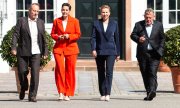
Denmark: Frederiksen forms a new coalition
Two months after the Danish elections, a four-party centre-left coalition government has emerged which, however, still falls short of a parliamentary majority. Prime Minister Mette Frederiksen's Social Democrats will work together with the Socialist People's Party, the social-liberal Radikale Venstre, and the Moderates. Frederiksen is now set to begin her third term in office.
Willing to make necessary compromises
A political culture of minority governments has been established for some time now in Denmark, notes the taz:
“There are no fewer than eleven other parties [in addition to the Social Democrats] in the Danish Folketing, whose share of the vote range from 11.6 to 2.6 percent. And there, too, this is naturally seen as a complicated starting point. ... As long as a majority doesn't oppose it in parliament, a minority government can rule the country. The word 'compromise' also played a major role in these most recent negotiations. Frederiksen's new four-party centre-left government can now get started with 82 seats, whereas 90 would normally be the magic number. The new coalition is relying on the support of the left-wing Enhedslisten party. The fact that the Moderates are on board with all this just goes to show how great the willingness to compromise is in Denmark.”
Europe's new Iron Lady
Forum24 looks forward to Mette Frederiksen's next term in office:
“Under her leadership, the Social Democrats won less than 22 percent of the vote in the March elections – their worst result since the beginning of the 20th century. Some commentators attribute this to the fact that she focused too much on foreign policy in the campaign and neglected domestic issues. Other observers, however, claim that it is thanks to her principled stances on Trump and Putin that her party won again. ... It's said that Frederiksen grows stronger with every crisis. ... Europe urgently needs leaders like her. Also to inspire others.”
Downgrade to opposition would have been better
Berlingske takes a critical view of the Social Democrats' approach:
“The government will be made up of the People's Socialists, the Moderates, the Radicals [Social Liberals] and, of course, the Social Democrats', said Mette Frederiksen … That little word 'of course' reveals something about Frederiksen's understanding of power. … Despite a historically weak election result for the Social Democrats and a shift to the right in the Folketing, Mette Frederiksen is set to become prime minister once again. It would have been refreshing for Denmark and beneficial for the Social Democrats' self-image had the party been sent into opposition. ... But it didn't turn out that way. At least this time, however, it is not an absolute majority government that can completely shut itself off.”
Hope is left of centre
Sweden will hold a general election this autumn. Aftonbladet sees the newly formed Danish centre-left government as a promising model:
“After years of building a centrist base, Frederiksen is now aligning herself with a red-green coalition. She is not completely abandoning the centre. But she is making it clear that governmental power is secured on the left, not on the right. There is a clear lesson for Sweden. ... When voters in our neighbouring countries face uncertain times, they do not turn to the right. They turn to social democracy. There are many indications that Sweden will be the next Nordic country to follow suit.”