
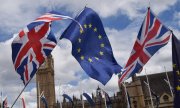
Ten years of Brexit: time for a reset?
Ten years after the Brexit referendum, a majority of Britons believe that leaving the European Union was a mistake. Leading Labour politicians such as the Mayor of London, Sadiq Khan, and former Health Secretary Wes Streeting, are calling for the UK to rejoin the EU. At the same time, the Reform UK party led by "Mr Brexit" Nigel Farage has been leading the polls for months. The press looks at where the country is heading.
The next decade will be better
The Independent is confident that things will improve:
“Most surveys of public opinion suggest that people judge Brexit to have been a mistake, and would gladly turn the clock back. ... Unlike 10 years ago, there is now a genuinely more constructive mood in Brussels and in London, and, while not tempting fate, geopolitics, demographics and the dismal cold reality of Brexit will see the UK build a new relationship, step by step, pragmatically and so consonant with public opinion that it avoids another national trauma. The next 10 years will be better.”
A vital partnership for Europe
London and Brussels need each other, political scientist Eitvydas Bajarūnas concludes in Delfi:
“From a European perspective, it's particularly crucial today that the UK and the EU continue to draw closer, especially in the areas of security, defence and economic cooperation. No one is seriously talking about the UK rejoining the EU, but geopolitical realities are forcing both sides into ever-closer collaboration. The economic aspect is no less important. The UK remains one of Europe's largest economies. London's financial sector, British universities, the start-up ecosystem and industrial potential are of great relevance to Europe's competitiveness and economic growth.”
Soften the red lines
What's needed now is pragmatism, argues political scientist Riccardo Perissich in Telos:
“The most urgent, concrete issues of mutual interest should be addressed with pragmatism: defence, security, relations with the US, innovation – including AI – and finance; all these areas are crucial for Europe to make a qualitative leap forward. For this to happen, both sides must be prepared to give some ground on their red lines. On the European side, this should be reflected in a willingness to discuss new rules with the UK before they are finally adopted – without, however, restricting either side's sovereignty.”
Farage's popularity a mystery
Savon Sanomat is puzzled by Nigel Farage's popularity:
“The frequent changes of prime minister prove that Brexit was a mistake. There can be no talk of political stability. The golden age promised by vocal populists like Nigel Farage, who championed Brexit, has never materialised. The EU's much-maligned bureaucracy has been replaced by the country's own bureaucracy. Instead of the soaring economic upturn that was cast as a certainty, Brexit is now seen as having slowed down growth. ... In light of the rising opposition to Brexit, Nigel Farage of the Reform Party – who is once again emerging as a key figure in British politics – is a surprising phenomenon.”
A cautionary tale for Malta
Brexit shows just how deceptive nationalist promises can be, writes the Times of Malta:
“The UK left the room where the rules were made, only to discover that those rules still mattered profoundly to its economy and security. Malta, by contrast, gains leverage precisely by being inside the Union – at the table, in the negotiation and part of a market and political bloc far larger than itself. ... Malta should take careful note. In an age of insecurity, fragmentation and geopolitical competition, our strength lies not in retreat from Europe but in serious, confident and constructive engagement within it.”
Labour must work to rejoin the single market
The Independent points to the devastating consequences of Brexit and makes the case for rejoining the EU:
“Leaving the European Union has reduced UK GDP by between 6 and 8 percent. Investment has plummeted by an estimated 18 percent. ... [P]roductivity and employment has reduced by three to four percent.... [P]eople in towns like Wigan voted for Brexit because they wanted change – but Brexit quite obviously did not fix the economic and social problems that drove that vote in the first place. If Labour had any sense, they'd follow their gut instinct and work on rejoining the single market.”
Warning against radical change
We must all learn from Brexit, Večernji list cautions:
“Brexit will be lodged in the collective memory as a warning, not just to Britons but to all EU member states: If you leave the EU, you will end up like Britain! ... It's not the first time that an ideological movement calling for radical change justifies its failure by saying that the idea was good, but it was tricky to put into action. If nothing about it worked, then perhaps the idea was no so great after all.”
Populist politics are a dead end
De Volkskrant spells out the lesson to be learned from Brexit:
“Moderate politicians such as Prime Minister Keir Starmer have no chance in the harsh post-Brexit climate. The Brexit fiasco shows yet again that pandering to the electorate in an attempt to take the wind out of the populists' sails is a dead end. It generally results in mismanagement, which plays yet further into the hands of the populists. It is also a warning to all those who foment Euro-scepticism to win elections. Yes, the EU has undeniable disadvantages, but life outside it is a lot worse.”
EU better without the British
Jordi Juan, editor-in-chief of La Vanguardia reflects on how the EU has fared without Britain:
“Many key decisions, such as the creation of the Next Generation Fund, the European Green Deal or immigration policy, might not have been supported by the British, or only with great difficulty. The UK never joined the Schengen Agreement or adopted the euro. It was always reluctant to fully commit itself to Europe. ... If that hadn't been the case, and if young Britons were more pro-European, the UK would be an excellent partner and would greatly strengthen the EU.”
Self-deprecating humour sorely missed
The EU has learned to get by without the UK, notes The Economist:
“In many ways the EU has remained the same. English is even more of a lingua franca in Brussels than it was in 2016. ... Perhaps the biggest impact of Brexit was on EU morale. The bloc out-negotiated Britain at every turn of the four-year-long divorce. That gave it confidence to face later crises, whether covid or Ukraine. Yet the self-deprecating humour of Britain's EU contingent remains sorely missed, even among their former ideological enemies.”
Europe has shifted to the right
Brexit has permanently changed Europe, according to an analysis by historian Andrew Knapp in Le Monde:
“Brexit and the nature of the Brexit campaigns have ushered in a decade of decisive victories for the far right across the globe. It is now on the verge of attaining political power in both France and Germany, and is already firmly entrenched in Italy. It is also gaining influence within the EU. ... In the unlikely event of the British returning to the EU, they would find a completely different Europe to the one they left ten years ago.”