
Europeans launch new defence alliance
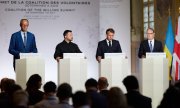
Several European countries have agreed in Paris to form an alliance with Ukraine for joint missile defence, with the declared aim of deterring and neutralising threats. In addition, the Coalition of the Willing declared its readiness to guarantee Ukraine's security in the event of a ceasefire and announced multinational military exercises in Poland.
Show of strength and unity
Macron is sending a clear message, notes Corriere della Sera:
“This year's Bastille Day took a different turn. This time Emmanuel Macron wanted to give it more of a European twist than ever before. Consequently, the military parade was opened by a small contingent of 25 Ukrainian soldiers, who were greeted by the crowd with prolonged applause. They were part of a formation of around 500 soldiers from European countries – including Italy – as well as other nations that share Western values, such as Canada. They are all part of the Coalition of the Willing. This demonstration of strength and unity was intended to instil confidence in European citizens – and perhaps also to irritate Russian President Vladimir Putin.”
EU military union an illusion for now
A loose defence alliance is forming in Europe, says Der Standard:
“As the US withdraws from Europe, a restructuring is once again underway, as seen at the grand military parade in Paris on 14 July. A formation representing a 'Coalition of the Willing' marched in the parade. This coalition was launched by France and the government of the UK, which is no longer an EU member. Their aim is that if a ceasefire is reached in Ukraine, 'the willing' are to secure it militarily. This is a diverse coalition of 35 states - excluding the US - almost all of which are members of Nato and/or the EU, including Germany, Italy, Poland and Romania. Norway is involved, as is neutral Austria. An EU military union therefore remains, for the time being, a pipe dream. A new, loose European alliance is a more realistic prospect.”
France filling the gaps in air defence
Latvijas Avīze takes a look at the situation with Ukraine's air defence:
“Although US President Donald Trump announced on 9 July, immediately after the Nato summit in Ankara, that he would grant Ukraine a licence to produce Patriot missiles, observers don't expect the process to be quick. It will take at least two to three years to complete this bureaucratically and technically complex task. Germany received a licence to produce the Patriot system in 2022, but the first missiles won't be manufactured until 2027. ... On a positive note, French President Emmanuel Macron has promised Zelensky an unspecified number of French SAMP/T air defence systems "in the coming weeks". That's better than nothing, at least.”
Woe betide us if Le Pen takes over
Macron's foreign policy legacy is hanging by a thread, says Le Soir:
“However unpopular Macron may be in France, no one can deny that for the best part of a decade he has done everything in his power to build a stronger Europe in a world dominated by new empires. … The worst thing, however, would be if the work Macron has done for Europe were to come to an abrupt end in ten months' time – when he welcomes his successor into the Élysée Palace. What a tragedy it would be if that successor were to be Marine Le Pen. The very politician who now wants us to forget that she benefitted from a Russian loan in 2014 and sought Putin's support in Moscow in 2017.”