
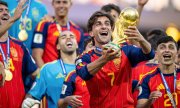
World Cup: taking stock after Spain's victory
The Fifa World Cup has come to an end with Spain’s victory over Argentina. Superstar Lionel Messi failed to secure a win for his team in the final – and Ferran Torres scored the decisive goal in extra time, giving the Spaniards a 1-0 lead. European commentators interpret the messages sent out by this World Cup beyond the sport results.
Europe must take the helm again
Berlingske is delighted that ultimately the World Cup was not marred by the unpleasant incidents surrounding it:
“Despite the backroom deals between Fifa president Infantino and US President Trump, the World Cup proved to be a celebration of football, with good or at least exciting matches, millions of enthusiastic fans and a final won by deserving champions. ... Football was invented in England, developed further across Europe, and later adopted around the world. ... Europe also dominated the World Cup – with three teams reaching the semi-finals and European world champions who deservedly beat a South American team. Europe must try to regain control of Fifa so that we can ensure orderly and decent conditions in the world of football.”
The Old Continent has trumped Trump
Ultimately, the World Cup was a defeat for the US President, Sydsvenskan observes:
“The tournament was, above all, proof that European openness trumps American isolation, and not just on the pitch. Europe celebrated in style, despite Fifa's attempts to sell the sport to autocrats, tournament by tournament: in Russia in 2018, in Qatar in 2022 and this year in Trump's US. For many Americans, the World Cup probably served as a reminder of the Europe that the US has turned its back on with its America First doctrine: Norwegians rowing in Times Square, Scots drinking beer in Boston, and seas of orange-clad Dutch fans in Houston. Without these images, football is nothing.”
The game is never over
Kathimerini takes a philosophical view of football and the World Cup:
“With friends, family and the rest of the country, we dream of magnificent displays and victories. When our team does well, we walk tall; when it loses, we hurt. And however cynical we may become with all that surrounds the game, we always return, ready to interpret yesterday, today and tomorrow through a game that unites us in joy, pride, anger, sorrow and hope. The fact that this time Greece did not even qualify, along with some even greater soccer nations (e.g., Italy), does not mean that the game is over. It never ends.”
Making the world stand still for a moment
El Mundo columnist AL celebrates Spain's victory:
“What a moment it was when Trump presented Spain – that 'ungrateful' nation, that 'hopeless case', that 'terrible partner' – with more than 20 gold medals. ... And to experience this day dancing on the beach with strangers, waving our shirts together, cheering in unison, crying, laughing, even stripping off our clothes. What a party! ... The national team has fired our imagination. What more could a society want at this time of night? ... There's no room for politics or the grime of everyday life, because this is just about eleven men and one ball and making the world stand still for a brief moment.”
Unexpectedly great
Sebastian Wendel, World Cup correspondent for the Aargauer Zeitung, was positively surprised:
“Can I really get excited about a World Cup in Trumpland? After six weeks in North America I'm looking back in amazement. Of course 30,000 kilometres to watch the six Switzerland games is nothing to boast about. But what will I remember in 30 years' time? The wonderful and astonishingly full stadiums. The consistently peaceful atmosphere. The 20,000 frenetic fans in front of the Colombian team hotel in Vancouver. The Argentinian in Kansas City who told me that he had sold his car to buy tickets. ... Even when the tournament threatened to implode after Donald Trump's intervention with Gianni Infantino, the sport itself saved the day – in the form of Belgium's indisputable victory over the host team.”
Symbol of excess
Record revenues are not enough to make the tournament a highlight, argues La Libre Belgique:
“Despite its financial and sporting success this tournament will be remembered as a symbol of football that has become mired in excess: a tournament expanded to include 48 national teams, a match schedule that continually pushed players beyond their physical limits, ticket prices that bore no relation to the reality of fans' lives, and a governing body that all too often either remains silent or puts on a show, as well as suspected political influence. ... Not to mention the racist remarks and the refusal to allow the Somalian referee to enter the US. ... Infantino will announce record revenues but his job is not just to boost turnover.”
Nothing is certain in football
The old football hierarchy has been upended at this World Cup, Le Figaro concludes:
“Brazil (five-times champion) no longer has any stars, and the German team (four times the champion) lacked inspiration: is this symptomatic of Germany's decline? And numerous African nations came close to providing big surprises: Cape Verde, Côte d’Ivoire, Senegal, Egypt… Is this the beginning of the rise of the South, whose players have often been trained in the North? … The World Cup has shown France once again that nothing is certain in football. In a country shaken by crises, people clung to the Bleus. … Seen as the favourites, they were expected to give the country new hope. … Alas! We were disappointed.”