
Wildfires: what steps should Europe take?
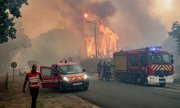
Devastating wildfires are still raging in France and Spain, with around 300,000 people having been forced to evacuate their homes. The fires are closing in on the cities of Bordeaux in France and Valencia in Spain, while in the area around Madrid the situation has eased slightly, according to the regional government. Commentators discuss what measures are needed beyond ad hoc responses.
Climate measures are a must
The wildfires show that there is no alternative to climate protection, argues The Guardian:
“Calls for the dilution of green measures are generally accompanied by the assertion that Europe needs to take a more pragmatic approach, at a time of geopolitical uncertainty and aggressive economic competition. The argument is wrong twice over: the faster the EU moves towards net zero, the better it will consolidate Europe's position in the global markets of the future. More fundamentally, as the appalling impact of this summer's wildfires vividly illustrates, the notion that climate measures are a kind of optional add-on, appropriate only when times are good, is wildly at odds with the developing reality.”
Prevention is key
Libération urges that our landscapes must be made more resilient:
“We urgently need to rethink the protection of our woodlands, as they account for more than a third of our national territory. Firebreaks must be seen as a means of prevention, rather than merely a response to danger. Pasture farming and vegetable cultivation must also be reviewed, as must the creation of protective green belts around residential areas. We must listen to those with expertise in the field, as well as to those who live in these areas, and engage in a profound re-evaluation of our landscapes. ... Only then can we prevent the next disaster a year or two from now while ensuring that despair does not turn into uncontrollable rage.”
End the precautionism
France should put more faith in its citizens, urges L'Opinion:
“It's time for a paradigm shift. Precautionism has had its day. … It is time for a paradigm shift. The era of precautionary measures is over. … This of course doesn't mean that the government should abandon those fleeing the flames. But it should seek to turn citizens – who are all too often treated as immature and irrational – into an additional tool in the multiplying battles. Civil defence requires citizens to be more self-reliant. … Instead of fuelling controversies and constantly making new announcements, the presidential candidates should focus on restoring a culture of risk-awareness and strengthening the self-reliance of the French people.”
Life in the age of megafires
In eldiario.es, author Isaac Rosa reflects on a grim future:
“My daughter was born in 2011, in the midst of an economic and social crisis which we've already forgotten. ... In 2036, she'll be 25 – a year that is presented to us in dystopian terms: perhaps 50 degrees Celsius will be the norm by then, and the fires we see today will be 'the fires that await us' – 'in the age of megafires'. ... This is how parents are seeing their children grow up: in a climate crisis where there are no plans to tackle it, barely any time to even try, and where no lessons have been learnt from one summer to the next. ... While the government calls for a national pact that would already come too late and climate change deniers gain ever more ground.”
Northern Europe also at risk
Northern Europe must also brace itself for large-scale wildfires, warns Aamulehti:
“The major fires in southern Europe are a painful reminder that climate action alone is no longer enough. Large-scale wildfires also pose a real threat in the Nordic countries, as became clear in southern Norway in July. In dry terrain and hot weather, a wildfire that got out of control destroyed at least 400 people’s homes. This could also happen in Finland and in Pirkanmaa [the region around Tampere, where the editorial office is located]. Are we prepared to deal with a scenario in which a large wildfire spreads uncontrollably and reaches the outskirts of populated areas?”
Climate change is destroying our environment
We are already seeing the consequences of climate change and they affect us all, warns La Libre Belgique:
“Until recently, the term 'climate refugees' invoked distant peoples displaced from their homes by rising sea levels, droughts or desertification. But now in Europe, our environment can become also uninhabitable within the space of a few hours. We, too, are potential climate refugees. ... Water, fire and heat are the three faces of the same vulnerability. It has long been predicted that these extreme weather conditions would become more frequent and more intense – now they are the new reality. Climate change is no longer just a curve in a diagram or a scenario for 2050. It can be measured in lost lives and devastated landscapes. ”
Invest in fire protection instead of weapons
Europe must change its priorities, demands La Tribune de Genève:
“You always reap what you sow. By prioritising military spending over civilian protection, by allowing the fleet of fire-fighting aircraft to fall into disrepair and refusing to heed the warnings about climate change, the authorities have given the flames free rein. The fires are becoming more frequent, faster and more violent. As long as there is still something to burn, they will continue to devour our countryside. And as long as public budgets continue to be geared more towards war than protecting the land, nothing will change. It is high time we said openly: the greatest emergency we face is not military – it is climatic, humanitarian and territorial. Looking the other way is no longer an option.”
Mutual accusations won't kill the flames
La Vanguardia is disappointed by the politicians' response:
“The responsibility is shared. The most obvious responsibility lies with the arsonists. ... But there are others too. Part of the blame lies with land owners who fail to maintain their forests properly. ... But the authorities are also to blame, particularly for so drastically cutting public investment that we are left defenceless against the all-consuming flames. And it is all the more annoying when rival politicians hurl accusations at one another. ... That certainly won't put out fires.”
Action still needed after conditions ease
Climate protection measures must not be sidelined once the fires have subsided, warns The Irish Independent:
“The wildfires on the continent are only the most intense illustration of the deeper plight of a warming world. Far more people will die in decades to come as a result of extreme heat than from the flames themselves. ... The hottest June on record just passed. It led to a reported 10,000 excess deaths across Europe. …The good news is that the heatwave looks set to ease over the coming days. Welcome bursts of rain are forecast in some areas. The concern is that the easing of conditions will become another pretext to quietly set aside what needs to be done until the next time.”