
Cyprus: Guterres to start new talks
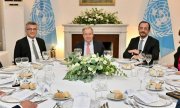
UN Secretary-General António Guterres has announced a new initiative to resolve the Cyprus conflict. During a visit to the island, Guterres said he had already received the go-ahead from both Cyprus's President Nikos Christodoulidis and Tufan Erhürman, the President of the internationally unrecognised Turkish Republic of Northern Cyprus. The guarantor powers – Greece, Turkey and the UK – will also take part in the talks.
Fresh momentum
The Cyprus Mail welcomes the outgoing UN secretary-general's initiative:
“Guterres said both sides in Cyprus were on board for a new conference as were the three guarantor powers, in essence meaning Turkey. This is a marked shift by Ankara but to what end is as yet unclear. For almost ten years it has insisted a two-state solution was the only way forward for talks after the failure at Crans-Montana in July 2017... Although Guterres set no deadline for a new 5+1 [conference], by virtue of his own departure from the UN in December, he has in reality initiated a countdown. His visit brought, if not progress, then at least a measure of momentum.”
The key is on the Turkish side
Phileleftheros is cautiously optimistic:
“Guterres's trip to the island, the talks he has been conducting, the contacts and all those involved outside Cyprus have breathed new life into hopes of a solution to the Cyprus question. ... It is also positive that the secretary-general has made it very clear that his initiative is based on UN resolutions. ... This is particularly important becausethe occupying power Turkey disputes this. There is therefore still a long way to go before the informal meeting can be convened. It will require hard work, patience and, above all, the will of the occupying power. This has been, and remains, the key to a long-term agreement on the Cyprus question. ”
A test for political realism
Political scientist Theodoros Tsikas expresses his hope in Efimerida ton Syntakton that all sides will be willing to compromise:
“Guterres doesn't want another fruitless high-level meeting. He wants a process that offers a realistic chance of reaching an agreement. … The question is whether both sides are prepared to make compromises. The final hurdle is not diplomatic but, first and foremost, political in nature. Success will be measured by whether the two communities and the parties involved can abandon maximalist demands and demonstrate the necessary political realism. For the first time in many years, the problem is not the absence of an international initiative. What is lacking is the political will to steer this initiative towards a sustainable and workable solution.”