
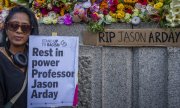
Who is responsible for Jason Arday’s death?
Jason Arday, a Cambridge professor who resigned in early August following allegations of plagiarism and inaccuracies in his biography, was found dead at his London home on Friday. In 2023, at the age of 37, the sociologist of education became the youngest Black professor to be appointed at Cambridge. University Chancellor Chris Smith condemned what he described as a 'racist feeding frenzy' prompted by the allegations against Arday.
Racism at work
Arday's death should make the right – which exploited his case as part of a culture war against diversity – stop and reflect, argues The Guardian:
“Arday became an exhibit in an ideological, almost Trumpian campaign against diversity and inclusion. The allegations were no longer simply about one academic's behaviour or his past record. They were used to suggest that Arday had never deserved to be there – and that he had only been advanced because of his race. The attacks were relentless, often partisan, and amplified without respite online. This is racism at work.”
Victim of a misguided form of anti-racism
Critical scrutiny must never be stifled, warns the taz:
“Because Arday's ascent was celebrated in a particularly high-profile manner and presented as evidence of progress for society as a whole, it logically aroused significant public interest. In a society that is meant to be held up to scrutiny in this way, awkward questions on such a matter are not racist, but legitimate. But instead of discussing the matter openly and honestly, those who had placed Arday in an untenable position stifled all debate. Arday was not a victim of racism. Rather, he is a victim of a misguided form of anti-racism that arbitrarily grants unfair advantages to individuals instead of systematically addressing unjustified disadvantages.”
Pawn in the inclusivity game
Svenska Dagbladet sees the whole affair as a warning:
“The alarm bells should have been ringing deafeningly. But there was such a strong desire to appoint a Black professor. One of Jason Arday's former mentors, who was interviewed by the New York Times, describes him as a pawn, a young man who was exploited by the system. They were so keen to appear inclusive that they decided to ignore the flaws in Arday's academic and personal history. This doesn't do the fight against racism any favours.”
The press lost all sense of proportion
The media should reflect on the role they played in Arday's death, the Irish Independent admonishes:
“His story was treated as if he were a senior politician who had lied his way to the top, deceiving the voters, or a criminal mastermind at long last brought to book. He was, as we say in the journalism trade, 'good copy'. A gift to the news desks and the opinion pages. ... The argument is not that the press should have ignored his shortcomings; it is that all sense of proportion was abandoned. This was cruel and it was careless. Will a lesson be learned? Not a chance of it. There will be plenty of talk about mental health and media pile-ons. Until the next time.”
Don't blame the media
The press was just doing its job, says The Daily Telegraph:
“The basic job of the press is to find out the truth. The basic problem with the account given by Arday, backed by Cambridge and its Faculty of Education, was that large parts of it were untrue. The evidence that he plagiarised the work of others is overwhelming – 180 incidents have been cited and sourced. ... The press found out substantial untruths, seriously damaging to the reputation of one of our two greatest universities and reported them. That is what you would expect of a 'responsible' press.”