
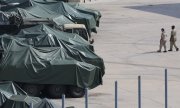
Trump scales back joint drills with South Korea
Shortly before joint US-South Korea military exercises are due to begin, US President Donald Trump has ordered them to be scaled back, citing both the costs and his relationship with North Korean dictator Kim Jong-un. He said their relationship was now "very good". The media examine the implications of Washington's U-turn.
Diversionary tactics gone sour
The South Korea controversy is intended to divert attention from Iran, Corriere della Sera suspects:
“This issue has pushed the failure with Iran into the background, but it won't change the final outcome. The Donald has lost out to the ayatollahs, he is exposing America to further rises in petrol prices (now back up to 4.50 to 5 dollars per gallon) and yields on the bond market have been soaring since yesterday. Above all, he has insulted the US's historic ally South Korea, which has transformed itself from a poor nation into an economic powerhouse and a flagship for Washington and its old geopolitical model. These contradictions are causing concern among sensible Americans and weakening Trump and the Republicans in the run-up to the mid-term elections.”
Frustration makes him even more irrational
Trump's loss of face in the Iran war is making him even more unpredictable, Der Standard warns:
“North Korea's tyrant is being courted while democratic South Korea is feeling his wrath for having quite rightly declined to take part in the Iran war. There is no strategy behind this, just the bad temper of an irrational narcissist who through his own incompetence has manoeuvred himself and his country into a highly precarious situation. For even Trump is well aware that despite the US's military superiority, the war against the regime in Tehran is lost and there is little chance of him being able to extricate himself from this mess while saving face. This is making him angry, unpredictable and dangerous.”
Iran the only exception
As Russia deepens its military cooperation with North Korea, the US president is praising his good relations with Kim Jong-un, notes Dagens Nyheter:
“Something interesting is unfolding in the US's relations with the anti-democratic Axis powers. Trump has already sided with Putin in the war of aggression against Ukraine. Now he also wants to strengthen ties with Kim, even though North Korea is supporting Russia's illegal war in Ukraine, has broken all its promises and built up a large arsenal of nuclear weapons. Trump's rapprochement with the 'axis of dictators' has so far had one exception: Iran. On the day that Iran, too, possesses a nuclear bomb, he may perhaps have a change of heart.”
Soon every country will want the A-bomb
TVNet comments:
“Trump's disagreement with Seoul touches on a fundamental question concerning the system on which American influence in the world has been based since the end of the Second World War. Washington guarantees the security of its allies, thereby reducing their need to seek other means, including nuclear weapons, to ensure their own security. ... It is possible that [the snub to South Korea] is merely another of Trump's loud statements, with no lasting consequences. Yet the message he has sent to the world is harder to retract. If his aim is to convince the world that acquiring nuclear weapons is not worthwhile, it is becoming increasingly difficult to deduce this from his policies.”
Making North Korea all the more dangerous
Trump is overestimating the positive impact of his overtures towards Kim, Rzeczpospolita criticises:
“In his negotiations with Pyongyang, Trump's main objectives are to reduce the immediate nuclear threat, bring North Korea's production of fissile material to a halt, stop nuclear tests and curb the intercontinental ballistic missile programme. Will this be possible? Hardly anyone believes it is. ... The opposite may even be true: improved relations with the US would strengthen Kim's regime and lead to Pyongyang's policy in Asia becoming even more aggressive.”
A shambles in foreign policy
Like Europe, South Korea must now also seek new alliances, Süddeutsche Zeitung concludes:
“The signal that Trump has now sent will mean that Seoul must look for new allies as quickly as possible. These could be as close as Japan or as far away as Germany or Canada. In this way, Washington is undermining a partnership that has been a guarantee of peace and prosperity for almost 80 years – not only throughout the Western world, but above all in the US. Whoever comes to power after Trump will no longer be able to pick up all the pieces.”