
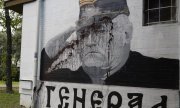
Serbia: state funeral for war criminal
Ratko Mladić, the Bosnian Serb former general nicknamed the "Butcher of Bosnia", died on Thursday in the United Nations Detention Unit in The Hague. He was sentenced to life imprisonment by the International Criminal Tribunal for the former Yugoslavia in 2017 for war crimes, genocide and crimes against humanity. Serbia's Minister of Justice, Nenad Vujić, has announced that he will be given a state funeral - sparking a major controversy.
Normalising the abnormal
Why does Aleksandar Vučić cast Ratko Mladić as a hero? In order to whitewash his own wartime and political record, Vreme notes:
“Mladić could always count on the radicals and their followers, who openly supported him. In rehabilitating him, they also rehabilitated their own political careers. Both sides needed the myth of the heroic general. And it worked: they controlled 90 percent of the media, and were able to normalise the abnormal. And in the process they destroyed political and public life. It will take a long time to recover from this. One of the tasks will be to relegate Mladić to his rightful place in history.”
Conspiracy theories and victimhood
Večernji list criticises the way Mladić and the war is portrayed in Serbia:
“'There were victims on both sides' is all one can get out of Aleksandar Vučić, but not without him turning the whole story on its head and calling the verdict an injustice against the Serbs, about whose bloodshed and sacrifices in his view nobody cares. He makes untenable comparisons between Croatian General Ante Gotovina, who was acquitted, and Ratko Mladić, who was convicted, to imply that the tribunal in The Hague is driven by a global conspiracy against Serbia. Apparently it's more important to preserve national myths of victimhood and instil them in new generations than to follow the European path.”
Strategic importance makes Belgrade untouchable
Europe's silence on the glorification of Mladić in Serbia weighs heavily, says Yetkin Report:
“Europe wants democracy, the rule of law and a reckoning with the past. But at the same time it wants stability in the Balkans and is trying to limit Russia's influence in the region. To this end, it does not want to lose Belgrade entirely. Serbia's growing strategic importance should in fact compel Belgrade to act more responsibly. In practice, however, the opposite is often the case. Strategic importance breeds political tolerance. ... More than thirty years have passed since Srebrenica. Back then, Europe vowed 'never again'. It is precisely this pledge that is being put to the test today.”
Scars of war remain
Mladić symbolised a deep division right until the end, Efimerida ton Syntakton explains:
“For many Bosnians he was the man responsible for the murder of thousands of people, whereas for a section of the Serbian population he was a soldier and defender of his people. The 'Butcher of Bosnia' is gone, but the wounds of war remain. In Bosnia, Muslims and Serbs continue to live side by side in a fragile climate of coexistence. The nationalist tensions that triggered the war of the 1990s, however, have not disappeared.”
Still yearning for a strong hand
Bosnia has not yet turned the page on Mladić, Kommersant FM comments:
“On the whole, one could say that those events have now come back to haunt us. There is no longer any authoritative, universally recognised body to resolve international conflicts; the UN is in a state of complete disarray. ... Basically, we've returned to the past, to the 20th century, perhaps even further back. Society is divided: there is neither a right, nor a left nor a centre. Instead, there is a longing for a strong hand, for men like General Mladić and his ilk – those who do not stand on ceremony and act without any regard for liberal mindsets, humanism or humanitarian law. It once seemed as though this chapter had been closed for good. Sometimes, however, the past comes back.”
For some a butcher, for others a hero
Perceptions of Mladić are extremely divided today, the Salzburger Nachrichten emphasises:
“His death is unlikely to bring any more reconciliation to his torn homeland than his arrest and conviction did. Opinions on Mladić will remain divided in Bosnia's fractured, multi-ethnic state even after his death. And while nationalist newspapers in Serbia are once again singing the praise of this supposed national hero, Ratko Mladić will go down in the history books as the 'Butcher of Bosnia' and as one of Europe's worst mass murderers since the Second World War.”
A sinister role model
Unfortunately many people - including several mass murderers - regard Mladić as an idol, Corriere della Sera laments:
“They still defend him, if not worse. Mladić has never ceased to fascinate other slaughterers, such as the Australian madman who murdered dozens of Muslims in Christchurch in 2019. Anders Breivik, the [Norwegian] white supremacist who carried out the Utøya massacre, claimed to have been inspired by Mladić. In Kalinovik, Mladić's home village, there's a monument with a huge portrait of the 'hero' Ratko. In Belgrade, his name is celebrated in hundreds of graffiti tags, and even the tennis player Novak Djoković boasts about associating with some of the former commander's friends.”