
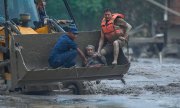
Devastating flood in the Himalayas
At least 472 people have died in a flash flood in the mountainous region between China and Nepal. The flood, which was apparently triggered by the collapse of a glacier, swept almost 170 kilometres along two rivers through Tibet and Nepal on Wednesday, destroying entire villages along the way. More than 1,400 people are still missing. Commentators see the disaster as a result of climate change.
Glacier meltdown
Polityka explains:
“The cause was most likely one of the Himalayan glaciers. ... A section of one of the glaciers broke off. It was so large that its collapse triggered an earthquake measuring 5.3 on the Richter scale. ... The incident is reminiscent of a tragedy in India in June 2021 in which 200 people lost their lives when 27 million cubic metres of material slid off a glacier – a volume equivalent to ten of the Great Pyramids of Giza. ... Recent studies have shown that the glaciers in the Himalayas are melting twice as fast as they were at the start of the century. And that is not without consequences.”
Decelerate global warming asap
The devastating flash floods highlight the gravity of the climate crisis, Dagens Nyheter writes:
“These disasters illustrate once again why it is in everyone's interest to slow down this trend as quickly as possible and not allow global warming to exceed 2 degrees. The measures required won't be for free, of course. But then again, neither will continuing to release emissions. ... The climate debate during the election campaign [in the run-up to the general election on 13 September] should really be focusing on these tragedies and the economic damage they cause. Instead, however, politicians are busily downplaying Sweden's significance and its total emissions – so that they can lower the price of petrol.”
Earth rebelling against abuse
Natural disasters like this serve as a warning, L’Humanité cautions:
“We would be mistaken to think that Nepal is so far away. What is happening today on the foothills of the Himalayas could just as easily happen tomorrow on the Alpine glaciers. A few days ago a tornado in Pomas near Carcassonne, one of the most powerful ever to hit the south of France, took us by surprise. ... It is not nature that is raging, but Earth that is rebelling against its abuse by a form of capitalism that is depleting the planet and its people. ... Humanity is paying the price for the greed of its leaders. ... We must also recognise a political dimension to this fury – and it will take a great deal of political will to bring about the radical change of course that we need.”