
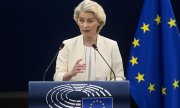
What did we learn from von der Leyen’s State of the EU address?
According to EU Commission President Ursula von der Leyen, the EU is, in priniciple, well equipped to meet the current challenges. "A stronger, independent Europe is now emerging", she said in her State of the Union address on Wednesday. She stressed, however, that more investment in defence as well as institutional changes such as the creation of a consultation mechanism in the event of a threat will be necessary to enhance Europe's defence capabilities.
The right diagnosis, but what about the treatment?
Info.cz comments:
“Von der Leyen has accurately diagnosed a number of very real European problems. The EU must become less dependent on China, streamline its bureaucracy, expand its technological capabilities and work more closely with trustworthy partners. It is no longer the diagnosis that Europe lacks. Achieving unanimity is not always the problem – around 80 percent of EU legislation is adopted by the Council by a qualified majority. Yet precisely in some of the most geopolitically sensitive areas, individual countries' right of veto remains intact. And it is in these areas, according to von der Leyen, that Europe wants to become faster, stronger and more independent. Putting this into practice is the real test for this year's State of the Union address.”
Moving towards a mini-Nato mechanism
The Neue Zürcher Zeitung welcomes von der Leyen’s idea of establishing a European Security Council:
“Ursula von der Leyen is right when she says: 'Hybrid threats facing Europe are less and less hybrid and less and less [mere] threats.' In view of this she has announced a new security strategy. Part of that strategy is a European Security Council and a mechanism similar to Article 4 of the Nato Treaty through which a member state can trigger consultations with all other EU member states to formulate a joint response. In a sense, this would create a mini-Nato within the EU. And that approach is entirely correct.”
Europe could bounce back
Népszava is cautiously optimistic:
“One of the key issues in European politics over the coming years will be whether the EU is truly able to become a global power centre. It still has a long way to go. Moreover, the process depends on the political climate in Europe, which is permeated by populism and currently gives little cause for optimism. ... However, time and again the European Union has weathered crises that many thought would paralyse it or tear it apart. ... In a world where a growing number of leaders view politics as a demonstration of power, it is in itself of great value when someone continues to seek a way forward through cooperation, compromise and rules.”
Neither heart nor soul
Keskisuomalainen was not impressed by the address:
“It was like Europe itself: rich, multifaceted, a little dull but democratic. The speech, which lasted nearly and hour and a half, covered four major themes: Europe's strategic autonomy, security, climate and technology, and values-based policy. The speech was nothing like the inflammatory rhetoric of US President Donald Trump directed at a cheering crowd of puppets or the monotonous addresses by Chinese President Xi Jinping to the National People's Congress. Nor was there any of the grandstanding typical of Russian President Vladimir Putin. ... Von der Leyen's annual address is significant on an EU scale, but it had neither heart nor soul.”