
Russia: Duma still firmly in Putin party's grip
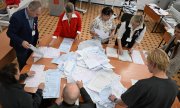
The United Russia party has secured a clear victory in the Russian parliamentary elections: according to the electoral commission it secured 58 percent of the vote. However, due to the allocation of direct mandates, the Kremlin's ruling party holds around 350 of the 450 seats in the Duma. The remaining seats go to four other pro-Kremlin parties; genuine opposition parties were not allowed to stand for election.
An unavoidable commitment to war
With this election result the Kremlin has granted itself a blank cheque to continue its policy of war, the Süddeutsche Zeitung comments:
“Unlike in democracies, in Russia it is not the people who teach the government a lesson at the ballot box but the other way round – the state teaches the people a lesson. The message is: the Kremlin has the situation under control. Anyone who doubts this is reminded every few years through these electoral rituals that they stand alone in their doubts and that a majority firmly believes in the regime. ... The absolute majority is therefore meant to be one thing above all: a declaration of support by the people for the war. Even if there was no other option on the ballot paper, in the end it is the people who pay the price.”
Conformity rules
In a Facebook post, political scientist Alexander Shmelev describes Russia's political system as one of total conformity:
“From now on, all public figures in the country must support all of Vladimir Putin's decisions, 'traditional values', social 'lynch pins', the war, the confrontation with the West, and so on with one voice. Any deviation on these issues is out of the question. ... In this model, 'elections' have definitively become a symbolic ritual, the main purpose of which is to reaffirm the absolute unity of the nation. Their 'results' are determined and confirmed in advance. There are no surprises.”
Russians opted for stability
The elections testify to continuity within Russian society despite the difficult circumstances, the Kremlin-affiliated newspaper Kommersant puts in:
“On the whole, the preferences of Russian citizens have remained virtually unchanged over the last five years even though the situation in the country has changed radically during that time. And this is arguably the biggest surprise of the 2026 Duma elections. After all, the outcome could have been a drastic radicalisation of political sentiment or, conversely, a noticeable rise in political apathy. Yet despite extremely unstable external and internal conditions, the Russian people have opted for stability.”
All signs point to further mobilisation
Delfi warns:
“Vladimir Putin is presenting the ruling party's victory as a sign of popular support, for himself, for the war and for the increasingly confrontational stance towards Europe. At the same time, the elections remove a domestic brake that had made unpopular decisions difficult or prevented them entirely. Consequently, Ukraine as well as the Russian opposition and Western think tanks are all reckoning with a mobilisation. ... In Europe there are currently no fears of a large-scale conventional attack. However, intelligence from Western secret services and Russia's recent behaviour suggest that the Kremlin may be preparing to test Nato through a shadow war.”
President for life?
With this overwhelming majority Putin now has even more scope to consolidate his power, The Times comments:
“The president's friends are now free to impose emergency powers and martial law, to change borders, to rewrite the rules of referendums, to fast-track state budgets, to hike defence spending and to extend wartime economic controls without further debate. Given that the parliamentary opposition already votes in lockstep with Mr Putin on national security and foreign policy issues, the vote might seem to be a bit of autocratic window-dressing. But crucially, this win gives the president the flexibility to decide whether to rule for ever.”