
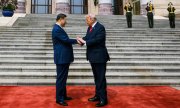
Xi visits Trump: what to expect?
Xi Jinping, China's president and general secretary of the Chinese Communist Party, is due in Washington for a state visit today. The talks between the two superpowers will focus on contentious issues of global relevance: the truce reached last year in the trade war over tariffs and rare earths is due to expire in November. The regulation of AI, Taiwan, Iran and Ukraine are also on the agenda.
We need an AI hotline
Political scientist Linas Kojala doubts on LRT that the meeting will result in a breakthrough on AI security:
“Nuclear missiles or launch systems can be counted and verified. With AI models, however, the situation is considerably more complicated. What's more, a large proportion of the most advanced systems are developed by private companies. Nevertheless, there is already a precedent. In 2024, Joe Biden and Xi Jinping agreed that the decision to use nuclear weapons must be made by a human, not by artificial intelligence. This is a very narrowly defined agreement, but it shows that there is common ground on this issue. ... To begin with, a permanent channel would suffice for discussing serious AI incidents and exchanging information about any dangerous behaviour exhibited by systems.”
Together they can stop Putin
In a Facebook post, Viktor Schlinchak, Director of the Institute of World Policy, voices the hope that Trump might persuade his Chinese counterpart to change course on Russia:
“Trump on his own won't be able to stop Putin, but together with Xi, who will be in the US tomorrow on a state visit, he might just be able to. Xi is aware of Donald's current domestic and geopolitical (due to Iran) vulnerabilities and will therefore demand major concessions in return, including that he refrain from providing military support to Taiwan. That is why what happens tomorrow in Washington at the 'Big Two' summit is crucial. For both countries, this is an opportunity to take Russia out of the picture.”
Truce will continue
TVNet doesn't expect the summit to change relations between the two countries in any way:
“The current dialogue is focused on shaping their relationship rather than on jointly resolving global issues. ... The US and China will continue to compete over technology, supply chains and influence in the Asia-Pacific region and there will be no immediate change on the Taiwan issue. Rare earths, chips, sanctions and tariffs will continue to be used as leverage. If, after Xi's visit, both sides continue to prepare for the upcoming meetings at the APEC Summit in November and the G20 Summit in December, the current truce will merely be extended by a few months.”
Same flaws instead of far-sightedness
Trump and Xi are more alike than they would probably like to admit, the Financial Times believes:
“Both Trump and Xi love pomp and ceremony. There will be plenty of that in Washington – but there is likely to be little serious engagement on the issues that matter to the world. This will not be a modern equivalent of the Reagan-Gorbachev Reykjavik summit of 1986, where the two leaders discussed radical nuclear disarmament and glimpsed an end to the cold war. Trump and Xi represent rival nations. But, unfortunately, the two leaders have many of the same flaws – narcissism, nationalism, narrowness of vision. The world needs far-sighted leaders.”
How much will the US risk for Israel?
The meeting sheds light on the crucial issues surrounding the Iran conflict, writes former World Bank economist István Dobozi in Népszava:
“Washington must now also consider how much it is prepared to risk in its relations with the world's second-largest superpower in order to exert maximum pressure on Tehran. ... This is where the question of Israel's 'strategic cost' really comes into play. If the consequences of a war with Iran extend to US-China relations, the global economy, energy prices and US military capabilities, it will become increasingly difficult for Washington to assume that the interests of Israel and those of the United States automatically coincide.”