
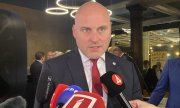
Latvian elections: clear victory for incumbent PM
Prime Minister Andris Kulbergs' United List has secured a clear victory in Latvia's parliamentary elections. Its share of the vote tripled to more than 35 percent, giving it 41 of the 100 seats in the Saeima. The pro-European centre-right party only needs one coalition partner now. The populist party Sovereign Power, which is described as pro-Russian, won 12 percent of the vote and 15 seats.
Flawless performance from political newcomer
In a Telegram post republished by Echo, political scientist Alexei Makarkin explains why Kulbergs' party did so well:
“A 35.2 percent share of the vote is an all-time record for modern Latvia. ... When the government, which had been accused of failing to protect the country from invading drones, collapsed in May, Kulbergs took over as head of the new cabinet despite never having served as a minister – he had worked in the private sector before being elected to parliament in 2022. In the months that followed his appointment, the prime minister made no mistakes and steadily built trust by presenting himself and his party as an alternative to the New Unity [previously the strongest party].”
Hard times ahead for science and environmental protection?
On Satori, philosopher and journalist Artis Svece voices concern that Kulbergs' policies are too efficiency-driven:
“Kulberg presents himself as a person with a business mindset: he wants clear results, he wants action rather than talk, he thinks in economic terms and aims to cut red tape, waste and inertia. ... Such 'business-minded leaders' pose problems for science, culture, environmental protection, public organisations and, clearly, any other sectors that cannot demonstrate their immediate utility within the hierarchy of values underpinning this ideology. ... Sectors not regarded as economic drivers will probably have to fight for survival in the coming years.”
Free hand in picking a partner
Historian Roberts Rasums explains in Delfi that the prime minister's party can now govern virtually unchallenged:
“Kulbergs has no need of either populists or pro-Russian forces and can simply continue with the current governing coalition. His alliance will most likely dictate the terms and can essentially secure any ministerial position it wants, including key posts such as defence, finance and foreign affairs. It should be pointed out that aside from New Unity, any political force represented in the Saeima would suffice for Kulbergs to form a coalition, which also means that no party can establish itself as the centre of a counter-coalition.”