
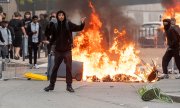
France: school protests escalate into violence
Schoolchildren in France have been voicing their anger over the shoddy conditions at their schools for several weeks now. School blockades have led to riots and clashes with the police, who have arrested hundreds of young people. Student representatives have distanced themselves from the violence. Meanwhile, France's Justice Minister Gérald Darmanin has said it is unclear whether those responsible for the violence are actually enrolled in school.
The left is starting a rebellion
Mélenchon's party is taking advantage of the student protest to rally support in the run-up to the presidential election, warns The Daily Telegraph:
“In seven months' time, the French will choose their next president, and Mélenchon is doing two things. First, he has already begun campaigning, galvanised by early polls showing that he could make it through to the second round to face the far-Right's Marine Le Pen. Secondly, Mélenchon is preparing the insurrection he hopes will follow if Le Pen is elected. He knows the country is fragile and will use every lever at his disposal to fracture it further and sow chaos. Politically, he doesn't mind appearing violent – quite the opposite.”
Mélenchon’s plan won’t work
Although Mélenchon and La France Insoumise appear to be benefiting from the protests in the short term they should not count their chickens before they hatch, Welt's Paris correspondent Martina Meister advises:
“The presidential election in France is due to take place in six and a half months' time. By then, even the left-wing populist Mélenchon is likely to realise that his strategy isn't working. When street battles rage, when parents have to live in fear that their children will come home injured, it only serves to amplify the call for law and order. ... The right-wing populist Marine Le Pen is likely to benefit most from this.”
Shooting themselves in the foot
The form the protest has taken is distracting from the real problem, argues Népszava:
“When a school entrance is ablaze, a headteacher is attacked, or furniture, buses or public buildings are set on fire, one can hardly claim that such acts serve to improve the education system. ... Violence serves to divert attention from the crux of the matter, and this works in the government's favour. ... After all, it's much easier to talk about arrests and troublemakers than about the fact that even though France is one of the wealthiest countries in Europe it is unable to provide its pupils with equitable and acceptable conditions.”
A beleaguered generation
In Belgium too, school pupils are protesting for better education. The young find themselves in the midst of a massive crisis, Le Soir explains:
“'Nobody is trying to listen to us,' they continue to protest these days, from Liège to Paris. So they're raising their voices to make themselves heard. And now their protest has spread from schools to universities. ... How can one not feel angry in the face of these dark clouds looming over the horizon of a youth already marked by Covid? This generation has marched for the climate, to no avail. It has marched for peace, which now seems like a utopia. It has grown up with technology that is now associated with dystopia. These are all legitimate fears, some of which are drowned out by the clamour of anger, but which must be heard and taken seriously.”
Breaking their silence
Today's French youth is by no means out of touch with reality, writes Jean-Emmanuel Ducoin, editor-in-chief of L'Humanité:
“The very pupils we thought were quiet and apathetic are now making their voices heard. They are coming together and demonstrating. ... We now realise that their deafening silence may not have been what we thought it was. Young people may fall silent in front of their screens, but they speak out when it comes to their schools, their living conditions and their future. So here's a question: do we still know how to listen? And how should we let them have their say? These pupils whom we took for 'silent' are asserting themselves as engaged citizens. ... They speak out loud and clear when an emergency arises.”
LFI mayor legitimising riots
Commenting on the protests in Contrepoints, political scientist Nicolas Lecaussin criticises Bally Bagayoko, mayor of Saint-Denis from the radical left-wing La France Insoumise party, for echoing the pupils' criticism:
“When he condones attacks on police officers and teachers in his town and describes those who have allegedly 'failed to uphold the republican promise' as the real culprits, he is not engaging in politics, he is conveying the message to young people in his town that the law is negotiable, depending on the merits of the cause. This is the definition of what the rule of law is not. ... So on Monday, teenagers learned from their mayor – an elected representative of the people – that arson, vandalism and confrontations with the police can be justified if they serve a good cause.”
President has failed in fight against extremism
Macron has allowed the political fringes to gain strength, Le Figaro criticises:
“Seven months before the presidential election, the firebrand candidate Jean-Luc Mélenchon is pulling out all the stops. True to his 'cuckoo strategy', he intends to exploit every expression of anger to stir up and channel conflict. Not only is he using school pupils as electoral cannon fodder, on Tuesday he also appeared alongside striking civil servants, while his supporters joined the Parisian firefighters' march. ... Emmanuel Macron was elected twice on the promise of being a bulwark against the Rassemblement National. We see now how that has turned out. Moreover, never before has the far left been so strong in France's major cities.”