
Witkoff meets Putin: the upshot?
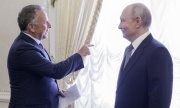
Following the meeting between Vladimir Putin and US Special Envoy Steve Witkoff in St Petersburg, talks between Russia, Ukraine and the US are set to resume. However, Witkoff describing Putin as a "humanitarian" during the meeting has drawn criticism even from US Republicans. The press looks at who stands to benefit from Trump's attempts at mediation.
Embarrassing and incompetent
Der Standard takes issue with the American special envoy's fawning praise of Putin:
“No one has ever called him that before. That's a first. How will Vladimir Putin react to Donald Trump's envoy, Steve Witkoff, calling him a 'humanitarian'? Witkoff is a property developer and Trump's golfing buddy, and together with Trump's son-in-law Jared Kushner, he keeps meeting up with Russian envoys and Putin himself in a bid to end the war in Ukraine. Two wheeler-dealers with no clue about foreign policy who have achieved absolutely nothing so far.”
Kremlin relying on attrition
The US's haste risks rewarding Russia for its patient strategy, La Stampa warns:
“Putin can already derive political advantages from the negotiations, without having to halt the war. Winter will put this strategy to the test. Moscow will seek to weaken Ukraine while the Ukrainians try to protect their cities and hold the front line. In the meantime, acts of sabotage, cyber-attacks and disinformation aim to undermine European unity and the consensus on aid to Ukraine. Putin is banking on wearing down Ukrainian resistance and the West's willingness to support Ukraine.”
Russia's victory by no means certain
Ukraine is not about to throw in the towel, says Aamulehti:
“Even if the United States were to side fully with Russia, the war in Ukraine would not end. The massacre in Bucha has shown what happens to Ukrainians at the hands of the Russians, which is why Ukraine will not give up the fight. How long would the war last, and how would it end? Recent history answers that question. France waged war in Indochina for eight years. The US fought the Vietnam War in that region for 20 years, ten of which with its own troops. The Soviet Union waged war in Afghanistan for ten years, and the US for twenty. Each of these wars ended in defeat for the major power waging the war.”
Diabolical old men
Writing on Facebook, author Carina Cockrell-Ferre discusses the possibility of a Russian attack on Europe:
“The greatest danger facing Europe is that Putin could form a full alliance with Trump, who then assures him that he will not honour the terms of Article 5 of the Nato Treaty. ... This could indeed lead to a Russian attack on Europe. This is the common ground over which these two diabolical old men have joined forces. ... While Europe may be able to block a bad deal for Ukraine, it is powerless to push through a good one. All it can do is delay a Russian attack on Europe by supporting Ukraine and its armed forces.”
Kremlin giving no sign of being ready to negotiate
Future meetings are also unlikely to yield any tangible results, The Spectator observes:
“There has been nothing to suggest yet that the Russian president is genuinely ready to make a deal or concede on his war aims. ... Facing the prospect of brutal midterm results for the Republicans in two weeks' time, Trump is desperate for a win with Russia. Putin can sense this and appears to be using this to play for time ahead of a winter in which he hopes to make substantial progress on subjugating Ukraine. Not for the first time, it is Zelensky who is being forced to jump through hoops and show willing in the hope that doing so will save his country from a stitch-up by an enemy and supposed ally.”
Encouraged to escalate
The US's policies of recent weeks are having repercussions across the world, the Frankfurter Allgemeine Zeitung points out:
“Putin and his inner circle are convinced that in the war against Ukraine and their struggle against the West as a whole, they will firstly have the greater staying power, and secondly be able to play the Americans and Europeans off against one another. Everything the American leadership has done in recent weeks confirms this belief. Consequently, the prospect of a ceasefire, not to mention peace in Ukraine, has become even more remote. Instead, the Kremlin is likely to feel emboldened to escalate the conflict even further. 'Restoring justice of Russians' takes place above all on the battlefield, Putin's foreign minister has said.”
Moscow can take its time
Unlike Trump, Putin is not in a hurry, notes Corriere della Sera:
“For five years now, Vladimir Putin seems to have been applying the old Russian proverb 'The slower you go, the further you'll get' to a war that he originally thought would last no more than two weeks. … So Putin is biding his time, waiting to see how events unfold and what happens with the elections in the US and Europe – and taking whatever he can get without making any concessions. He has the chance to achieve in Washington what he is unable to achieve on the front line; but he also knows that this window of opportunity could be closed again by a single social media post in the middle of the night. ... What the Russian president needs to work out now is whether the path available to Trump will be long enough.”
Trump wanted Putin to win all along
The US President's supposedly new stance on the war in Ukraine is not really new at all, argues Dagens Nyheter:
“Some interpret this as the US changing sides with regard to Ukraine, and it's easy to understand why Zelensky feels betrayed. Yet this development is nothing new. The difference is that Trump is no longer making a secret of what he has wanted all along: for Russia and his friend Vladimir Putin to win the war. ... Trump's eagerness to help Putin now is particularly good news for the Kremlin. Russia is in a bad way, both on the front line and at home, where all its oil depots are burning. So it's good that it has an ally in the White House.”
What is going on in his mind?
Experts will continue to puzzle over the US president's policy on Ukraine, says Ilta-Sanomat:
“A clear intention can certainly be discerned behind Trump's confused remarks on Ukraine and Russia. He wants to take credit for bringing about peace. But does anyone still believe he could actually achieve such a thing? After all this, can anyone still trust Trump's word when it comes, for example, to security guarantees for Ukraine, which are a key safeguard for peace? ... When the war in Ukraine eventually ends and Trump is no longer president, a lot will be written about current events. Perhaps the most important question then will be: what on earth was going through Trump's mind? It won't make for pleasant reading.”