
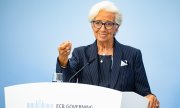
Why is ECB President Lagarde stepping down?
The President of the European Central Bank, Christine Lagarde, will vacate her post ahead of schedule on 7 February 2027, the bank has announced. Normally she would have remained in office until October 2027. European commentators speculate on what prompted her early resignation and how things look regarding who succeeds her.
Central bank strengthened
Naftemporiki applauds:
“The photogenic Christine learned from her early mistakes and provided the stability and guidance that the Eurozone countries needed during some of the most difficult moments in recent history: the Covid pandemic, the supply chain crisis, the energy crisis triggered by the war in Ukraine and, most recently, the war in the Middle East. She was there when national governments and Brussels could not find a solution to the successive crises or agree on a common fiscal policy. She leaves behind a strong central bank and a strong euro as it heads into the digital age.”
Saving Europe from Le Pen
The ECB president has done the EU a great service, praises the Süddeutsche Zeitung:
“By stepping down as President of the European Central Bank (ECB), she is ensuring that her successor must be chosen before the French presidential election in the spring. It will therefore be up to Emmanuel Macron to have a say in who will be responsible for European monetary policy in future. In this way Lagarde is preventing a potentially far-right French president from influencing who is appointed to this key position. By resigning, she is seeking to save Europe from Marine Le Pen.”
Unprecedented changing of the guard
Corriere della Sera comments:
“Lagarde must have realised that an agreement is emerging between the leaders in Paris and Berlin regarding the key appointments that will shape the structures of the European Union. Not only must an ECB President be elected within 45 days; alongside him (or her), a chief economist must be found to take up the post in May, as well as the person who will coordinate the central bank's market operations, who must take up the post immediately. An unprecedented changing of the guard. ... The three most influential members of the six-person Executive Board, which runs the world's second-most important public financial institution from Frankfurt, are all being replaced.”
Independent spirit needed
The Frankfurter Allgemeine Zeitung hopes that her successor will steer a clear course of stability:
“Europe's heavily indebted states, first and foremost France, must resolve their budget problems themselves. The central bank cannot and must not shoulder this burden. We need an ECB President who stands for such a course and who is trusted to stay it, even in a Europe where right-wing populist parties may wield greater influence. ... Politicians must not choose a successor simply because he or she is easy to get along with. The great achievement of former US Federal Reserve Chair Jerome Powell was to counter all of President Donald Trump's hostility with the sobre application of central banking principles. The ECB now also needs such an independent spirit.”
Paris must remain visible
France must secure its influence within the EU, the business paper Les Echos urges:
“Should she have remained in her post in Frankfurt, which she is due to vacate on 7 February, while the financial situation in her home country France is deteriorating and the ECB may one day have to intervene in some form? ... The argument cuts both ways: a Frenchwoman will always be suspected of wanting to give Paris too much of a helping hand. ... So what now? Paris must capitalise on its support for Klaas Knot or Pablo Hernández de Cos – and not just by securing one of the vacant posts, be it that of chief economist or market specialist. ... Faced with Germany, it is crucial that France remains visible in Europe.”
Zero women in top posts
El País laments that it looks like only men will remain on the bank's executive board:
“Lagarde's departure triggers a reshuffle at the top of the ECB. It will allow the capitals to agree on who will head the eurozone's key financial institution even before the start of an electoral cycle that will set the course for the entire continent. ... The former governors of the Dutch Central Bank, Klaas Knot, and the Bank of Spain, Pablo Hernández de Cos, are the frontrunners. ... Lagarde's departure also means the exit of Isabel Schnabel as a member of the Executive Board. ... With the departure of Lagarde and Schnabel, the ECB will be left without any women in senior roles or among the 21 governors of the Eurozone's central banks. ... This is an unacceptable anomaly for any European institution.”