
Overthrow of Maduro by US: international law no more?
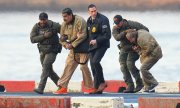
Venezuelan President Nicolás Maduro, who has been taken prisoner by the US, has stated in a New York court that he remains the legitimate president of his country and that he was "kidnapped". The 63-year-old rejected accusations that he abused his office and promoted drug trafficking. European commentators focus on the question of whether the US operation was legitimate.
A costly illusion
International law has never been a guarantee of peace, writes Observador:
“What really secured 80 years of peace between the major powers was not 'international law' or the United Nations General Assembly, but the nuclear balance. When the Cold War came to an end and people started to believe this concept was outdated and that a 'new international order' would emerge with a tendency towards liberalism, democracy and peace, it quickly became clear that this was an illusion – an illusion for which many are paying a high price.”
Ineffective without robust defence
Europe must be bolder, Denník N urges:
“The most important lesson Europe can learn from Venezuela is the simple but uncomfortable fact that international law only carries weight if it can be implemented by force. Without a robust defence and the willingness to take bold decisions, such as using frozen Russian assets to support Ukraine or taking action against ships transporting Russian oil, invoking legal norms in a time of increasing international tensions and confrontation between major powers becomes a source of weakness rather than security.”
Latin America's collective memory sounds the alarm
Sociologist Manuel de la Fuente voices concern about Colombia, Mexico and Brazil in eldiario.es:
“Several generations of Latin Americans remember the US military interventions in the second half of the 20th century. ... The consequences left numerous countries stained with blood and led to dictatorships that complied with Washington's interests. ... This is not the first time the US has placed excessive trust in its military superiority, which turns out to be insufficient for implementing a viable plan the day after. ... If the attack on Venezuela goes unpunished, why shouldn't Trump also invade Colombia, Mexico or Brazil? ... What happens in the next few weeks weeks and months will depend on the rest of the continent's reaction.”
All about power and the interests of the powerful
In a commentary on the +Portal website, former diplomat Božo Cerar sees a new international order beginning to take shape:
“The actions of the US confirm fears that a new international order is emerging in which international law applies primarily when it aligns with the interests of those with the greatest power. The UN and its charter are becoming less important, while the logic of power and spheres of influence are gaining significance. This is also confirmed by the US's new Security Strategy, in which it explicitly defines the Western Hemisphere as its sphere of influence. This is an updated version of the 19th-century Monroe Doctrine and a clear departure from liberal internationalism.”
The battle for hearts and minds will continue
Postimees weighs up the situation:
“The world's strongest army can defeat any tyrant. However, the battle for the 'hearts and minds' of the people takes years. The Americans must ask themselves whether they are capable of taking cultural differences into account. Are they capable of quickly improving living conditions, as was the case in Europe after the implementation of the Marshall Plan? And is the goal to hold free elections as quickly as possible or is the focus shifting to oil production? In conclusion, the toppling of a tyrant won't make the world a worse place if the alliances among democratic states remain intact and we use democracy to keep things in order in our own countries, including Estonia.”
No concern about legitimacy
With this operation, the transformation of the world to conform to Trump's ideas has begun, Habertürk warns:
“It can be said that this operation is not just a harbinger of a 'new order' that is increasingly under discussion but represents an extremely significant step. International legitimacy plays no role here. Such legitimacy is not being sought for either the operation itself or Maduro's prosecution. ... The National Security Strategy signed by Trump at the end of last year emphasised the priority of US interests in the Western Hemisphere. ... The first concrete step towards securing the Western Hemisphere has been taken via Venezuela.”
Washington pinning its hopes on puppet leader
Trump is solely interested in oil, power and money, comments columnist Alan Friedman in La Stampa:
“The EU's reaction to Trump's 'kidnapping' of Maduro has been weak so far. Perhaps the Europeans thought Trump wanted to replace the regime in Caracas with a democratically elected president. This may happen in the future, but for now, Maria Machado, like Zelensky before her, has been given to understand that she doesn't hold all the cards. With Delcy Rodríguez, on the other hand, Trump and Rubio think they have bought themselves a puppet. In Washington, it is taken for granted that the United States will renegotiate the oil concessions and claim a share of Venezuela's assets.”
Colonialist tactics
Journalist and social democratic politician Irene Lozano criticises Trump's plans in eldiario.es:
“The motivation behind this is Venezuela's oil and natural resources. Trump is repeating colonial patterns: he is brazenly seeking to control a sovereign country for his own vested interests. ... Installing friendly governments in other countries in order to exploit their resources is something he has in common with Putin's imperialist vision. ... The Venezuelans have been freed of Maduro, but there is no democracy in sight. And the world is paying a high price: international law is becoming weaker; the UN, the OAS [Organisation of American States] and multilateralism likewise, while the culture of war is growing stronger.”
Only Venezuelans have the right to decide
Clara Gérard-Rodriguez, a lawyer specialised in international law, appeals in Le Monde:
“There is nothing in international law that allows the United States to intervene on the territory of another state to capture its leader. Regardless of the legitimacy of Nicolas Maduro's power or the crimes he may have committed, only the Venezuelan people have the right to decide their own future through a democratic process and their judicial authorities. ... Only the strict application of international law and the punishment of violations of it – irrespective of the perpetrators or their motives – can still save the international order that emerged from the ruins of World War II.”
New hope for millions
Die Welt's Latin America correspondent Tobias Käufer applauds the move:
“Maduro was one of the main causes of the world's largest migration movement in the last decade. Removing him from power and bringing him to justice should actually be the task of the UN and the International Criminal Court in The Hague. But they failed. Now Donald Trump has taken matters into his own hands. And he will have given new hope to many millions of Venezuelan families. Whether this hope can be fulfilled by a new beginning in the country remains to be seen. At least there is now a small chance of this happening. And that is more than has been achieved by all other attempts over the past 13 years.”
Europe must focus on getting stronger
Seznam Zprávy looks at what conclusions Europe must draw from this:
“It has to recognise that the new geopolitical division of spheres of influence is a reality and that the alliance with the US is a thing of the past. The response to this should be a deepening of supranational European cooperation. Firstly, stronger coordination of security and defence policy. And secondly, a focus on the zones of influence that are crucial for Europe, especially its eastern borders. The world order in which norms and rules applied at least formally is transforming into an order in which the law of the strongest prevails. So the only option is to become stronger, and this is only possible for European states through mutual cooperation and defence.”