
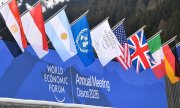
Davos: what can the WEF achieve?
The World Economic Forum (WEF), which brings together leading figures from business, politics and science, is taking place this week at the Swiss resort of Davos under the motto "Spirit of dialogue". All eyes are now on US President Donald Trump, who before boarding his plane to head to the meeting today said he believed a solution would be found in the dispute over Greenland that would make Nato and the US 'very happy'.
Focus on defusing Trump
Latvijas Avīze formulates Europe's main objective at the Economic Forum:
“Completely unexpectedly, it has turned out that Europe's leaders should not be focusing on how to protect themselves from Russia and improve the world, but rather how to counter Trump's absurd ambitions and his threats to engage in an economic war. 'Defusing' Trump has become the main goal of European politicians and diplomats in Davos. Unofficially, it is known that Europeans are coordinating their contacts with those large US companies that would suffer from Europe's countermeasures. The aim is to persuade business executives to look for ways to influence Trump's entourage and Trump himself.”
Actually a place for dialogue
Unfortunately, Trump has now chosen Davos as his stage, laments Corriere del Ticino:
“If the WEF stands for anything, it is dialogue between strategic partners. ... But instead, Davos 2026 has become a stage for the strategy of tariffs as an instrument of geopolitical blackmail, at the expense of cooperation. Tensions between Europe and the United States are being played out using tariffs and the threat of commercial countermeasures, and Trump is travelling to Davos today with the clear intention of underlining his global supremacy under the 'America First' banner.”
Russia's envoy more at ease than Zelensky
Ukraine is being sidelined from Davos this year, Corriere della Sera notes:
“Volodymyr Zelensky was reluctant to attend because he saw it as a mockery of himself and his country, which has resisted brutal aggression for four years. Instead, after four years, the aggressor, Russia, has made a comeback: Kirill Dmitriev, a product of Harvard, Goldman Sachs and McKinsey, who now acts as a negotiator on behalf of Vladimir Putin, appeared yesterday morning in the snowy Swiss landscape and mocked the 'collapse of globalism'. Naturally, he feels more at ease than the Ukrainian president in today's Davos, dominated as it is by the eccentric personality of Donald Trump.”
A meeting full of opportunities
The World Economic Forum offers many opportunities, writes Madeleine von Holzen, editor-in-chief of Le Temps:
“The WEF and Switzerland have a card to play. ... There are decisions to be made and prepared. Should we invest in the United States or not? Should we look for opportunities elsewhere? Should we form strategic alliances with certain countries? Or use all legal means at our disposal to defend ourselves? ... As this conference kicks off, we have a request: ladies and gentlemen, elected and appointed representatives, political and economic decision-makers, make use of this platform! Help improve the state of the world and make Davos a real success. Even if that task seems more difficult than ever right now.”
Climate policy successfully sidelined
Jornal de Notícias criticises the forum's focus:
“Although the World Economic Forum - a kind of Oscar ceremony for influential politicians, lobbyists and magnates - addresses the future of the planet in a 'spirit of dialogue', it is less concerned with the health of the globe and is focused almost exclusively on the wars that are springing up all around like poisonous mushrooms. It's strange how the focus on the environment has been supplanted by that on weapons. ... In this world there are no gelatinous monsters or teenagers with special powers, like in 'Stranger Things'. But what awaits us is no less frightening.”
World Geopolitical Forum more accurate
The agenda at Davos has expanded considerably, notes Corriere del Ticino:
“Given the significant presence of geopolitics, it might more accurately be called the World Geopolitical Forum today. However since much of its work continues to focus on the economy it is still called the World Economic Forum, even though its remit has expanded significantly over time. Geopolitical issues and, in many cases, politics itself have become far more important at the annual meeting in Davos in January. ... This year, there is another element: the direct presence of US President Trump, accompanied by a large American delegation.”
Silence on the biggest threat
The political and economic elites refuse to engage in an honest debate about the destructive economic system, criticises philosopher Ingrid Robeyns in The Guardian:
“Everything suggests that, once more, what will not be addressed at their meeting is the biggest threat to humanity and the planet: neoliberal capitalism. ... The transition from mixed economies under social democracies to neoliberal capitalism has led to a notable increase of wealth concentration at the top, which is now eroding (and in some places even destroying) our democracies. The absence of a sustained discussion of neoliberal capitalism in elite circles is illogical, since it is the main cause of the other problems that will be discussed at Davos.”
An American colony
Davos is dominated by Trump and his agenda this year, La Repubblica writes:
“The Davos forum, the summit of global and globalist elites, multilateralism and dialogue, really looks like an American colony this year. Or rather, a colony of the Maga empire. The programme revolves entirely around Trump. ... Both in its official agenda, in which 'woke' issues such as the fight against climate change - typical for a forum that is always politically correct - are much less visible, and in the parallel agenda, the real highlight, which includes announcements on Gaza and meetings on Ukraine with Zelensky and European heads of state and government.”