
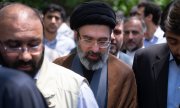
Iran: Ali Khamenei's son to replace him
Mojtaba Khamenei is to take over as Iran's supreme leader after his father Ali Khamenei was killed in an US-Israeli airstrike. The Israeli military has now threatened to target the successor. US President Donald Trump had declared beforehand that he considered Mojtaba Khamenei to be an "unacceptable" choice, and that any Iranian leader who did not meet with Washington's approval would "not be long in office".
Regime sending a clear message
It comes as no surprise that Iran's Assembly of Experts chose Mojtaba Khamenei, Dnevnik explains:
“His appointment sends a clear signal that despite this war the regime is not about to give up the Islamic Republic, whose path has been determined by his father's leadership for the past 37 years. ... The choice of Mojtaba Khamenei underscores the regime's familiar stance that it will do everything in its power maintain its rule. This was already evident in January when, after Trump's first announcements to protesters that help was on the way, the rulers mercilessly gave the order to open fire on demonstrators.”
Barely known yet already a target
Mojtaba Khamenei remains in the background, Corriere della Sera observes:
“The son was elected, but has not yet appeared in public. ... Most Iranians don't even know what his voice sounds like. For years he's been referred to as a shadow figure, his father's right-hand man, the representative of the Revolutionary Guard, treasurer and manager of oppression, but he's never appeared on television. ... His followers will have to wait to get to know the third supreme leader of the Revolution. The first, Ayatollah Khomeini, died in his bed; the second, Ayatollah Khamenei, was killed by Israeli-American missiles on 28 February. The third, Mojtaba, risks the same fate.”
Israel and the US want different things
Trump isn't seeking a new direction in Iran, but as with Venezuela all he's after is someone who'll cooperate with the US, Krytyka Polityczna writes:
“That means someone from the ruling circle who has control over the state apparatus, including the armed forces, and who is willing to cooperate with the US. As far as Iran is concerned, only few of the candidates on the US list of successors are still alive. One after another they're being killed in Israeli attacks. Because Israel just happens to be opposed to a 'Venezuelan scenario' in Iran. For Jerusalem it's a question of destroying the regime, not of having a 'lite' version of a change of guard.”
No letting down the guard under Mojtaba
With Mojtaba Khamenei a bitter hardliner has assumed the leadership in Iran, The Economist comments:
“Before the war, some had speculated that Mojtaba might become Iran's version of Mohammed bin Salman, the Saudi crown prince who sloughed off clerical control and eased confrontation with Israel. But the killing of his family is likely to have extinguished such hopes. His hallmarks are more likely to be paranoia and retribution. ... If so he may prefer to preserve his father’s hostility towards Israel and America, to resist internal reform and to entrench the IRGC's grip.”
Trump becoming a global threat
Corriere della Sera is unsettled by Trump's show of power vis-à-vis Iran:
“In Trump's world the fig leaf of humanitarian intervention has fallen. ... All that counts is what the commander-in-chief of 'the strongest and most powerful by far military in the world' wants. ... Centuries of praise for democracy and self-determination of peoples end up in the bin. Six words: I will choose the new leader. For him the only indispensable characteristic of the new Iran is that it is obedient. Like Delcy Rodriguez in Caracas. Like Cuba must be. And here comes the point that robs his enemies of sleep and should also disturb his friends. Is there still a deterrent that can prevent Trump from taking what he wants?”
Not going to Washington's plans
For Jutarnji list Trump is naive to think that he will be able to choose the Iranian leadership himself:
“Trump ignored the warning from the US National Intelligence Council. ... Its recommendations call into question the plan announced by the president for a swift elimination of Iran's chain of command and the installation of a new leadership in Tehran that suits Trump's tastes. ... In contrast to Trump's optimism, Iran's spiritual and military leaders have developed protocols to guarantee continuity of power in the event of Ayatollah Khamenei's assassination.”
A regime without supporters
Only a government that has the people's backing is legitimate, T24 puts in:
“The violent and immoral attack on Iran could temporarily strengthen the regime. However as long as the regime's loss of legitimacy persists, the historical trend will not change. Violence can maintain order, fear can enforce silence, external threats can unite the elites. But nothing can permanently replace popular consent. Therefore, the fundamental issue for those in power is not security but legitimacy. Security is a result of legitimacy and can't replace it. ... A regime without supporters cannot survive.”
Tehran banking on exhaustion and chaos
The Mullah regime is playing for time, writes Diário de Notícias:
“Iran has understood that Donald Trump faces an internal problem: the war is deeply unpopular with the majority of the US population, including his Maga supporters. The Iranian strategy is therefore to bide its time, spread chaos in the region and to try to extend the conflict to the Gulf States and other sensitive areas in the eastern Mediterranean region. At the same time, the regime is trying to inflict as many casualties on the US forces as possible in the knowledge that even minimal casualties will have a powerful impact on the American public, which is sick and tired of the 'eternal wars' in the Middle East.”