
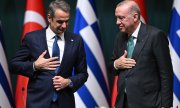
Greece and Turkey: talks at the highest level
Greek Prime Minister Kyriakos Mitsotakis and Turkish President Recep Tayyip Erdoğan signed several agreements at a long-postponed meeting in Ankara on Wednesday, despite tensions over territorial issues in the Aegean Sea and the unresolved Cyprus question. The relationship remains highly sensitive, media in both countries stress.
Mitsotakis more open to dialogue
Mitsotakis wants to further improve relations with Turkey but he faces resistance in Greek society and politics, observes Yetkin Report:
“It was not surprising that Defence Minister Nikos Dendias, who does not support the 'positive agenda' in relations with Turkey and rejects Mitsotakis' steps to improve relations, was not included in the Ankara delegation. [Turkish] Foreign Minister Hakan Fidan had already stated at the annual review meeting in early 2026 that it was clear that the steps towards cooperation that Mitsotakis was seeking would be blocked by individuals and groups in Greek politics and media who are opposed to reconciliation.”
No illusions please
Naftemporiki warns of Erdoğan's real intentions:
“It is undoubtedly positive that the channels of communication between the two sides remain open. But let's not entertain any illusions. When the time comes, Erdoğan will 'sell' the warm hospitality he showed the Greek delegation in Ankara to the US and Europe to push for what he has being pursuing from the outset: Turkey's neo-Ottoman, revisionist foreign policy. But also to quell any reactions in the US Congress and the EU to Ankara's arms and defence demands. Especially when US President Trump decides to turn his attention to Greek-Turkish relations. And that moment does not seem to be far off in view of his planned visit to Turkey in early July to attend the Nato summit.”
No sign of a historical turning point yet
Easing the tensions will require significant further effort, HuffPost Greece believes:
“The key question remains: Can dialogue transcend its role as a 'pressure valve' and contribute to a solution? ... Experience teaches us that Greek-Turkish relations move in cycles. Periods of détente alternate with periods of tension. The challenge is to transform this cycle into a linear process of gradual de-escalation. This cannot be achieved with a single meeting or a cheerful photo opportunity. What is crucial is continuity of contacts, the deepening of confidence-building measures and the systematic avoidance of actions that poison the climate.”
Only strong partners can benefit
It's in Greece's interest to negotiate with Turkey, news website Liberal explains:
“Let's remember that Germany and France were once archenemies and are now the two key allies who jointly lead Europe. Greece and Turkey cannot promise anything comparable at this stage. But both countries have everything to gain from improved relations. With responsible political leadership, Greece can protect its vital interests. If that happens, everything else will be easier. Otherwise, the weak will become easy prey for predators. But under Kyriakos Mitsotakis, Greece is not weak.”
Misotakis sticking to his guns
Eleftheros Typos also praises the Greek Prime Minister:
“Never before has a Greek Prime Minister so clearly and unequivocally demanded the removal of the casus belli during a visit to Turkey [Ankara has considered any extension of Greek territorial waters to be a cause for war since 1995]. Neither his predecessors, who criticise him, nor anyone else has ever taken such a step, and this shows how important it is for Greece to continue discussions with Turkey without making the tiniest concessions and always asserting its justified claims. However the isolation that some preach has done no one any good.”