
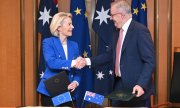
What will the trade deal with Australia bring?
After eight years of negotiations, the EU and Australia have agreed on a sweeping free trade deal. Once ratified, almost all tariffs and trade barriers will be removed, except for strict upper limits for certain foods such as beef. There are also plans to improve Europe's supply of critical raw materials.
Keep it up
The deal is more than just an agreement to remove tariffs, the Süddeutsche Zeitung emphasises:
“It is, above all, another signal. The Europeans are securing a new strategic partnership - hot on the heels of the historic agreement with the Mercosur states of South America and the deal with India. ... Secondly, the deal will secure the EU access to a large share of the critical raw materials that are essential for its economic future, most of which have come from China to date: materials like lithium, cobalt and rare earths. ... Thirdly, the separate partnership on security and defence means that Europe is taking seriously its new role in which one day it will have to stand on its own two feet militarily. ... We must keep going at this pace.”
Massive investment in mining needed
The free trade deal is a major opportunity for Europe, which must not be missed, L'Echo stresses:
“The wording of the deal will have no substance if European actors fail to spring into action. Mineral exploration and extraction in Australian mines call for massive investments and both public and private partnerships. But Europe is not alone in having an eye on Australian subsoil. The US is already one very important step ahead in this matter. Faced with intimidation from the world's two biggest economic blocs, now more than ever the EU must join forces with the 'middle powers', as the Canadian Prime Minister Mark Carney called for in his famous Davos speech in January. ”
Ratification not a given
It's not in the bag yet, Adevărul points out:
“It's all purely theoretical until we know whether the European Parliament will ratify the agreement or, as some sectors of the European trade union movement are already predicting, there will be renewed protests – some of them violent – and on an even larger scale, much like those that took place when the Mercosur agreement was being negotiated. What's more – but this is a matter for individual states – it is possible that this agreement will require ratification by national parliaments. And that will likely prove complicated as many member states are due to hold key elections next year and the farmers' protests are likely to turn into a 'no' vote.”
Spurred into action by Trump
De Standaard praises Brussels' negotiating dynamics:
“This is a rules-based agreement between allies who are committed to liberal democracy and from which both sides stand to benefit. Among other things, the EU gains better access to key raw materials for the energy transition. The deal with Australia follows hot on the heels of the Mercosur agreement. In both cases, the negotiations dragged on for many years, were declared a failure on several occasions, but gained new momentum as a result of Trump's trade war. In times of crisis, even friends who are very far away provide a safe haven.”