
EU-India trade deal: pros and cons?
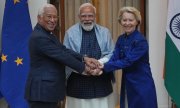
The free trade agreement concluded between the EU and India will abolish or reduce customs duties on 90 percent of the bilateral trade and save European exporters up to four billion euros annually in duties, according to EU Commission President Ursula von der Leyen. The media highlight the global political significance of the partnership and the associated risks.
Tariff policy reshaping the global economy
The EU is pursuing a very different economic policy than the US, Keskisuomalainen explains:
“Trump's tariff policy has already prompted Europe to strengthen its trade relations with other parts of the world. ... The EU wants to achieve competitiveness and low tariffs through trade agreements. The United States could end up becoming its own customs island. Time will tell how the US economy develops under the protection of tariffs. The EU has chosen a different path. It is striving for low tariffs and aiming to benefit from an open market economy. ... The global economy is undergoing major upheaval. This could bring big surprises in the coming months and years.”
Europe cleverer than the US
Handelsblatt responds to the criticism from the US:
“Secretary of the Treasury Scott Bessent complains about Europe opening up to trade with India, while at the same time the US is trying to use tariffs to dissuade India from doing oil deals with Russia. ... The US view is too short-sighted. Whether it likes it or not, India is a country that sees its independence in foreign policy as part of its national DNA, so the expectation that the government in New Delhi would bow to American pressure and end its oil trade with Russia was never realistic. The European approach is likely to prove wiser. Instead of making India feel blackmailed, the EU is offering partnerships on equal terms.”
Brussels flexing muscles with a friendly smile
The agreement with India proves that in recent months Europe has become a factor in global politics, Večernji list writes:
“The EU has finally begun to behave like a geopolitical player, albeit differently from other geopolitical players. European leaders don't make a lot of noise, they don't make threats, they don't show off in their social media posts, and they treat others with respect. But just because the EU is not loud and doesn't bang its fist on the table doesn't mean that it is incompetent or clumsy. Europe doesn't need to act like a power. Ukraine, Mercosur, Greenland and the agreement with India are proof of this, and all this shows a clear strategy. The EU is slowly positioning itself as a third pole between the US and China.”
Nothing will happen before 2030
If you look at the facts, the deal won't bring any major changes, Weltwoche complains:
“Trade between the EU and India accounts for just 2.5 percent of the total European trade in goods. A 50-percent increase is now expected. That may sound great, but it would still only account for 3.75 percent of the total trade. Sensitive issues such as raw materials and agriculture have been excluded as a precaution. The rest is also far from settled. Years of discussions about details and legal technicalities lie ahead. And of course, approval by the EU Council and Parliament will be required before anything can get off the ground, so nothing will happen before 2030. What is clear is that India has gained more advantages. Textiles and leather goods will flow into the EU in even greater quantities.”
Europe facing exodus of industry
Economics professor Jože P. Damijan warns of negative consequences in his blog:
“Under conditions of European stagnation, drastic regulation, uncertain supply, extremely high energy prices and very high labour costs, the reduction of customs duties on industrial products could have a similar effect to that experienced by American industry after China joined the WTO in 2001 – namely, an exodus of European industrial companies or a massive shift of industrial production to India. ... To a country with an enormous pool of extremely cheap labour, reliable supply chains and low energy prices (Russian gas and oil), a large domestic market, weak environmental legislation and open access to key regional and global markets.”
More geopolitical clout
The EU will benefit immensely from the deal with India, says the Salzburger Nachrichten:
“In the long term, the benefits and symbolic significance are likely to eclipse the Mercosur agreement. India is an interesting partner for many reasons: not only because the country is a huge market with one of the highest growth rates in the world, but also because working with the world's most populous country will automatically increase one's geopolitical clout. The pact could also help the EU to defend its values in an increasingly harsh environment.”
Europe is not doomed
Der Standard welcomes the trade agreements with India and Latin America:
“There is a narrative that right-wing and far-right parties in Europe are exploiting and that is now also being supported by the White House. It goes like this: the EU is heading for collapse. ... Through the EU deal with India and the finalised Mercosur agreement, Europe is finding new allies and new markets. At the same time, we are offering an alternative narrative to that pushed by Trump: cooperation can produce two winners. Stand up more resolutely to Europe's opponents, reach out to friends: this is how things can work out in this new world order.”
Soon also partners in spirit
The EU is ignoring India's democratic backsliding, political scientist Christophe Jaffrelot criticises in Le Monde:
“Although India is becoming increasingly illiberal, Europeans continue to regard it as 'the world's largest democracy'. ... Not only are religious minorities still victims of daily discrimination and violence, not only has civil society been brought into line by the authorities, but convincing evidence of electoral fraud has also been presented. ... The EU is remaining silent on these issues not only because realpolitik is perhaps becoming the norm in order to resist Trump, but also because the ideological focus of Europe and the EU Parliament is shifting. ... In the long term, the rapprochement between the EU and India could also be based on ideological common ground.”
Time for post-colonial humility
Despite all the differences, Europe cannot ignore India, the Süddeutsche Zeitung stresses:
“Europe's democrats should have no illusions about this. Prime Minister Narendra Modi's government pursues an India-first policy which it sells as 'cultural nationalism' based on traditional Hindu values. ... Modi and President Vladimir Putin get on well. India buys Putin's cheap oil. And in September, 65 Indian soldiers took part in a military exercise in Russia. Europeans may not like all this, but getting up in arms about it won't help now. ... Lecturing and post-colonial arrogance would be counterproductive. India is a giant that is struggling to stand up right now. It won't let anyone belittle it anymore.”
Romania could be a bridgehead
Ziarul Financiar sees major opportunities:
“Indian companies from the renewable energy, pharmaceutical, IT and electronics sectors are already active in Ukraine and Moldova. Neighbouring Romania could become a bridgehead via which Indian and Romanian companies help to build up the two countries. So there is no need for 100 Romanian companies to set up shop in New Delhi; it will be enough for 100 Indian companies to come to the port city of Constanța or the cities along the A7 motorway. Romania's economic strategy is clear and simple: establish a partnership with India so that by 2030 we become the gateway and bridgehead for India in Europe. We can do it!”