
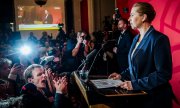
Denmark: what are the coalition options?
The Danish elections have failed to produce a clear winner and a left-wing coalition government is looking just as unlikely as one on the centre-right. The Moderates, led by former foreign minister Lars Løkke Rasmussen, could be the kingmaker, but Løkke is refusing to work with the Danish People's Party (DF), which has recently shifted to the right.
Spurious debates
The Spectator takes a critical view:
“This was a snap election campaign in which politicians ignored the elephants in the room (defence, foreign policy, Greenland) in favour of spurious debates about clean water ('who doesn’t want clean water?' groans a friend), pig welfare, school class sizes, and dog-whistle potential wealth taxes (in one of the world's most highly taxed countries). It ultimately produced a plague on the houses of the leader who called the election; the traditional opposition parties; and, by creating a period of possibly lengthy uncertainty during an international crisis, the electorate.”
The power of the kingmaker
European Pravda comments on the large number of parties that have entered the Danish parliament:
“None of the traditional blocs – neither the left nor the right – managed to secure a majority of 90 seats. This means that Denmark is entering a phase of having the most fragmented parliament in seven decades, in which each of the twelve victorious parties will attempt to dictate its own terms. The results mean that one person now holds the 'golden share' in Danish politics, able to bring order to the chaos and demand his price in return: Lars Løkke Rasmussen, leader of the Moderates – a political veteran who has already led the government twice.”
Moving closer to gender equality
Politiken notes with satisfaction that 86 of the 179 parliamentary seats are held by women:
“From a mathematical point of view, the invisible gender equality barrier has almost been broken, yet there is still a long way to go before men and women have equal power in the committees where Denmark's most important decisions are made. However, this doesn't alter the fact that the new gender distribution has put Danish politics in a better starting position. Not because everything depends on gender. But many things do in fact depend on it: if the prevailing economic models and GDP measurements systematically underestimate the value of care, housework and reproductive labour, this is due to the political over-representation of men.”
Frederiksen must lead and listen at the same time
As the weakened but still strongest parliamentary group, the Social Democrats now face the difficult task of forming a government, and for Politiken the following is clear:
“Mette Frederiksen should take charge and work towards a fresh start. ... After all, the Social Democrats are by far the largest party and the only one that can be described as something like a people's party. That is why Mette Frederiksen has the greatest democratic legitimacy to form a government in a new and extremely diverse Folketing comprising twelve smaller parties in total. However, this presupposes that she approaches both the other parties and the voters with an (honest) recognition of the new parliamentary reality that the electorate have created with their votes.”
A warning for the comrades in Sweden
The heavy loss at the ballot suffered by the ruling Social Democrats in Denmark should serve as a warning to their comrades in Sweden, where elections are due in September, warns Svenska Dagbladet:
“The Danish sister party is regarded as a role model by local party ideologues. ... The electoral debacle is a well-deserved slap in the face for the Social Democrats' ambitions for power. Neither cooperation with the centre nor the broad consensus on migration and legal issues appears to be enough to attract Danish voters. And the shift to the left, with a tax that – just as in Norway – would stifle the entrepreneurial spirit and drive enterprising citizens out of the country has become a real millstone around their neck.”
A conservative government must be possible
Berlingske calls on the leaders of the Danish People’s Party and the Moderates to set aside their differences:
“Morten Messerschmidt and Lars Løkke Rasmussen, make peace with each other now, you stubborn fools! Stop talking about mutually excluding one another from power and influence in Denmark. … Is there any attractive alternative to a broad coalition for the Danish People’s Party? Or for the Moderates? The cold, hard, objective answer has to be no.”
Unity instead of division
Politiken also calls on the parties to work together:
“In an unpredictable world, Denmark needs a government with leadership experience and political legitimacy that extends beyond the centre. … After an election campaign that unfortunately ended in increasingly relentless attacks from the trenches of bloc politics, the time has come to stand together once again and shoulder joint responsibility. Denmark needs a government that prioritises unity over division; the common good of the nation over narrow party-political interests.”