
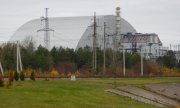
Forty years after Chernobyl: what has the world learned?
Forty years ago, Chernobyl, which was still part of the USSR at the time, was the site of the worst accident in the history of nuclear energy. A series of technical errors caused the reactor in Block 4 to explode on 26 April 1986. The leaked radioactivity spread across the whole of Europe and can still be detected today – in mushrooms, the bodies of wild animals and the forest floor. Commentators discuss the use of nuclear energy, then and now.
Don't forget the devastation
The fallout from the accident was enormous and should still give us pause for thought today, warns medical professor Duarte Barral in Público:
“At a time when we still need to look for alternatives to fossil fuels, it's important to remember the lessons of the past. If we take long-term indirect consequences into account, the number of deaths, according to WHO estimates, lies at 4,000. ... Then there was the evacuation zone that still extends across some 2,500 square kilometres today. ... The accident had such a profound impact that it may even have contributed to the collapse of the USSR five years later by exposing the weaknesses of the Soviet regime and its political culture of information control and secrecy.”
As if nothing had happened
Forty years after the disaster it's business as usual in Sweden – even in places where high levels of radiation levels were registered, Aftonbladet notes:
“Today the Chernobyl accident is all but forgotten. ... The current government has been pushing to expand nuclear energy since the last election. ... This would have been inconceivable a few decades ago. In summertime we have started eating a few mushrooms and berries again. But, when the Radiation Safety Authority measured the radioactivity in Swedish mushrooms two years ago, the levels at one location in particular stood out – in Hälsingland, in the north. The reading was four times above the safety limit.”
Keep the focus on renewables
The taz sees no point in reviving nuclear power in Germany:
“Although nuclear power stations are low emissions (not emission-free!), new plants are extremely expensive and take a long time to build. Not even the major energy companies are talking about this option. ... Wind turbines and solar panels have become ever cheaper in past few decades. They produce no radioactive waste that future generations would have to worry about for hundreds of thousands of years. And they pose no global threat in the event of accidents or military attacks. That's why the resurgent climate movement in Germany has overwhelmingly pushed for wind and solar power – with only a small minority backing nuclear.”
Coal is the real killer
The wrong conclusions are being drawn about Chernobyl, rails nuclear scientist Tim Gregory in The Spectator:
“If European nuclear generation had continued growing at even a quarter of its pre-Chernobyl rate, we'd have had enough electricity to replace every coal-fired terawatt-hour on the continent by 2009. Instead, we continued burning coal for another four decades, killing more than 300,000 people in the process. We continue burning it today. It kills thousands more each year. We treated a rare nuclear accident as uniquely intolerable, and we quietly accepted the routine carnage of coal. Europe's coal hangover is one of the great energy-policy failures of modern times: a victory of fear and aesthetics over reason and sound judgement.”
Dangerous but irreplaceable
The Ukrainian service of Radio Free Europe assesses the pros and cons of nuclear energy in wartime:
“Nuclear power stations are at risk in times of war, and there is a very real danger of a nuclear incident – particularly at enemy-occupied plants or ones in the line of fire. ... Yet nuclear energy has also proven to be essential during the war in Ukraine. Russian troops have massively targeted the Ukraine energy infrastructure, leading to significant power shortages and blackouts which were particularly devastating in a severe winter. Nuclear energy turned out to be the most important source of electricity in the end.”