
Should Europe invest in nuclear power again?
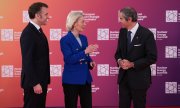
At a nuclear energy summit near Paris attended by representatives from around 40 countries, EU Commission President Ursula von der Leyen announced new financial support for nuclear power projects on Tuesday, describing the nuclear phase-out of recent years as a "strategic mistake". The development of Small Modular Reactors (SMRs) was also discussed at the meeting. Europe's press is at odds.
Von der Leyen's remarkable turnaround
Info.cz is amazed at the EU Commission President's U-turn:
“Ursula von der Leyen was the longest-serving minister in Angela Merkel's governments between 2005 and 2019 - which decided to accelerate Germany's nuclear phase-out after the Fukushima nuclear disaster. Von der Leyen was involved in all these decisions. ... Ursula von der Leyen's country was considered a shining example of nuclear phase-out. The question now is how quickly this strategic shift will be reflected in concrete European policy, and how the nuclear energy industry can be revived. As she said, 'We must start here and now.' What concrete measures will she take to follow up on these words?”
Eastern Europe on this path for some time now
With or without Brussels, part of the EU has already embarked on this course, wPolityce.pl points out:
“Recent years have shown that EU countries, including Poland, are working on SMR projects without following a strategy set by Brussels. A number of interested countries already formed a kind of industrial alliance to develop this technology in 2024. In addition, countries in our part of Europe are developing investment plans or preparing to build large traditional reactors. For example, the Czech Republic plans to double its nuclear energy production and is building new reactors in Temelin in cooperation with South Korea, while Bulgaria is building two units at the Kozloduy Nuclear Power Plant. In Pomerania, preparations are underway for Poland's first major nuclear power project.”
Many questions remain open
Der Standard is unimpressed by von der Leyen's initiative:
“The vulnerability of nuclear power is evident not only in the war in Ukraine, where Europe's largest nuclear power plant, Zaporizhzhia, has been shelled several times and has been operating in emergency mode for years. France and Switzerland also had to shut down their reactors during last summer's heatwave because the rivers were too warm to provide enough cooling water. Progressive climate change will further exacerbate this problem. And what about von der Leyen's hopes for 'small modular reactors', which are supposed to be safer and cheaper? They don't even exist yet. ... Before the EU promotes nuclear power as a new solution it needs to solve an old problem first. Even after decades it's still unclear where radioactive waste is to be stored.”
Don't waste money on this
Hoping that mini nuclear power plants will solve all the problems makes no sense, says tagesschau.de:
“Mini nuclear reactors are not just small and expensive, they also exist only on the drawing board so far. In the Western world, at least, there are no mini nuclear reactors in commercial operation yet, and in the US, private investors have jumped ship in droves. There is currently not a single supplier worldwide that can commit to a construction time and offer agreed costs, as Markus Krebber, CEO of Germany's largest electricity producer RWE, recently pointed out. His conclusion: zero willingness to take on such an investment risk. If the big players in the energy industry see mini nuclear reactors as a wasted investment, the EU shouldn't throw public funding at them.”
Use wind, sun and nuclear power
La Libre Belgique calls for greater integration:
“Europe's energy sovereignty is not only determined by power stations but depends on a much more comprehensive project: the electrification of the economy and the integration of networks on a continental level. ... Without a massive change in the transport, heating and industrial sectors, lasting independence won't be possible. In other words, this is not about choosing between nuclear power and renewables but about building a system capable of combining the two. The wind of the North Sea, the sun of the Mediterranean and, yes, nuclear power too, must be able to supply a truly integrated European grid.”
Pragmatic approach to nuclear power needed
It's time to think seriously about rehabilitating nuclear power, De Standaard urges:
“Nuclear energy polarises opinion far more than other energy technologies, and that's a pity. Nuclear energy has advantages and disadvantages. The same goes for other methods of power generation including wind turbines, solar parks and gas-fired power stations. Drawing up an energy strategy involves making rational decisions about the right energy mix. The question should not be whether Europe needs new nuclear power stations, but under what circumstances it might make sense to invest in European nuclear energy.”
Brussels now an advocate
Rzeczpospolita describes how the EU Commission has gradually revised its view of nuclear energy:
“For several years now, the European Commission has been changing its stance on nuclear energy. The breakthrough came in 2022, when it decided that gas and nuclear energy could be considered sustainable energy sources. ... The European Commission has gone from being initially hesitant about accepting nuclear energy as part of its decarbonisation strategies to being an enthusiastic advocate of this technology.”