
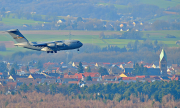
US troop withdrawal: empty threat or grave danger?
Donald Trump has announced a reduction in the US's military presence in Germany. Defence Secretary Pete Hegseth specified that 5,000 troops would be withdrawn, but the US President has since insisted that the number would be much higher. The announcements came after German Chancellor Friedrich Merz voiced criticism of Washington's strategy in the Iran war.
Furious Trump at an impasse
The US president is in a tight corner, writes Le Quotidien:
“Donald Trump's anger also stems from the refusal of NATO allies to support the US in its war against Iran. The US president is deliberately ignoring the fact that the Atlantic Alliance is a defensive alliance. ... At the same time, the Washington warmonger repeatedly insists that his army needs no help whatsoever to destroy Iran. In reality, he has indeed reached an impasse, as described by the Chancellor. Iran has presented the US with the challenge of choosing between an 'impossible' military operation and a 'bad deal'. ... Yet another humiliation for Donald Trump and his administration, who face difficulties not only on the war front.”
Bad timing for disputes
El Periódico de Catalunya voices concern:
“After a first year in office that was actually intended to raise spirits among Germany's citizens, Chancellor Friedrich Merz finds himself facing economic stagnation, low popularity, the rise of the far right and hostility from Donald Trump. ... And just at the moment when Europe needs Germany most to work towards creating a more competitive and autonomous EU, it is becoming increasingly difficult to predict the direction that this country in crisis will take. ... Europe needs Germany. ... We can only hope that economic recovery will curb populism and make it possible to strengthen one of the EU's essential pillars.”
Unavoidable side-effects of a good thing
Der Standard sees a pattern emerging:
“After Emmanuel Macron and Giorgia Meloni, Friedrich Merz has become the latest European head of government to fall out of favour with Donald Trump. By announcing the withdrawal of more than 5,000 US troops, the US President wants to punish the German Chancellor for criticising him over his war in Iran. The war in the Middle East waged so haphazardly by Trump is wearing holes in the European mantra: stay on good terms with the US president, flatter him, so that he doesn't get any silly ideas in his head. Europe is increasingly turning a deaf ear to the impulsiveness of the man in the White House. That's a good thing, but it has its side effects.”
Keep calm and rapidly rearm
The Independent urges the Europeans to push ahead with their defence plans:
“A US military withdrawal from Europe, if this is what President Trump is broaching, would be nothing less than the end to a key part of the post-Second World War settlement that has lasted since 1945. Representatives of both Germany and Nato say that they are seeking 'clarification' from Washington ... In the meantime, the best course for the Europeans is probably to keep calm and carry on with whatever plans they have for a defence system less dependent on the United States – and to do so as rapidly and as harmoniously as they can.”
Time for Europe to take charge
Former EU Commissioner Paolo Gentiloni calls on the EU in La Repubblica to take the bull by the horns:
“There's little point sugarcoating this. The announced withdrawal of American troops from Germany and perhaps also from Italy and Spain may be a symbolic act, but then defence is built on symbols. And if Trump ridicules Nato as a 'paper tiger', as if it were some tedious multilateral organisation rather than a powerful military alliance dominated by the United States itself, the Europeans will be forced to respond. ... Certainly not by contributing to the disintegration of the alliance, but by taking responsibility for our own defence. ... The days when the Americans were in charge will never return: nostalgia is not a strategy.”
Almost an invitation to the Kremlin
The Süddeutsche Zeitung is alarmed:
“Five thousand fewer GIs in Germany, that might sound bearable. ... But apparently a US artillery unit that possesses long-range missiles and cruise missiles will also be affected by Trump's decision. As agreed by Chancellor Olaf Scholz and US President Joe Biden in 2024, this unit was due to come to Germany this autumn. It was explicitly intended to send a message to the Kremlin of transatlantic strength, a tangible signal of deterrence. ... The fact that Trump is now cancelling the planned redeployment of this particular unit after spending yet another hour on the phone to Putin could – if one were pessimistically inclined – almost be interpreted as an invitation to the Kremlin.”
Let's hope Putin doesn't get any silly ideas
Columnist Pierre Haski comments in France Inter:
“The withdrawal of some of the 35,000 US troops still stationed in Germany will not change the reality of European security. ... Germany has announced an historic defence budget and, like the other Europeans, is preparing for life without the US. ... The true threat comes from Vladimir Putin, who could interpret the cooling of transatlantic relations as an invitation to test Europe's resolve.”
US Congress will not let this happen
Pùblico sees a complete withdrawal of troops as unlikely:
“Trump's threats are gradually losing credibility. When the president announces the withdrawal of the 37,000 American soldiers stationed in Germany, the threat is real, but putting this into practice will take years. It is from the American base in Ramstein, the largest on the continent, that the US armed forces coordinate part of their operations in the Gulf. It is also from military bases in Europe that the US can project its power into the Middle East and Africa. Withdrawal would be a massive own goal that Congress itself is very unlikely to authorise.”
Amateurism and arrogance
For De Volkskrant, Trump's threats are yet another sign of how much the US is isolating itself:
“In the wrangling for power, the Iranians have decades of knowledge and diplomatic experience to rely on, while in Washington amateurism and arrogance rule the day. Trump and his cronies are still in denial that this makes the US look completely untrustworthy and unreliable on the world stage. But from a global perspective, US isolation is already underway. Europe has now understood that dependence on the US must be reduced and new alliances forged.”