
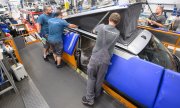
Job cuts at VW: symptomatic of German industry crisis?
According to media reports, Volkswagen is planning to reduce its global workforce of 657,000 by around 100,000 jobs over the next few years. In Germany, four plants belonging to Europe's largest car manufacturer could be closed in the restructuring. Other companies are also planning to axe jobs in Germany. Europe's media voice concern about Germany's future as an industrial hub and examine the causes.
Lagging behind
El País says Germany has missed the boat:
“The job cuts [at Volkswagen] are the result of an industrial transformation to which Germany has been too slow to adapt. ... For an export country, the global wave of protectionism is proving lethal. ... The risks are concentrated in Germany and the four plants threatened with closure, one of which is in the former GDR, a stronghold of the far right. ... Massive investment in the defence industry and the conversion of a few car factories into arms factories won't be enough, but the real tragedy is that the industry which sustained the economic miracle after the Second World War is becoming increasingly uncompetitive, and at the same time the country has been left behind by the new industrial revolutions.”
Too obsessed with debt
The job cuts are a consequence of restrictive fiscal policy, economist Michel Santi explains in La Tribune:
“The debt brake has treated current expenditure and future investments in the same way. ... Germany’s problem is its inability to prioritise the various obligations that have arisen simultaneously: reindustrialisation, investment, decarbonisation, modernising the country's defence capabilities and funding its ageing population. Borrowing money to maintain infrastructure, finance energy production or promote industrial transformation is not the same as borrowing money to maintain state payments or postpone reforms. The obsession with debt levels has pushed the key question into the background: how is the money being used?”
Energy transition to blame
Environmental regulations are the cause of the German car crisis, Trud is sure:
“Volkswagen is set to cut 100,000 jobs, Bosch 20,000, and Mercedes 40,000. The figures are shocking. The official reason is that their market share in China is falling and Chinese competitors are squeezing them out elsewhere. But let's not kid ourselves: the root cause of all this is the country's disastrous environmental policy and the energy transition, which have quite simply destroyed the competitiveness of German industry. ... And have they at least solved the climate problem? Not at all. As we can see, the emissions cut in Europe are simply shifting to China, where they increase tenfold.”
Tariffs are not the solution
It's not only in Germany that the car industry is suffering from overcapacity, the Neue Zürcher Zeitung writes:
“Many car factories worldwide are operating below capacity. In view of falling birth rates and the spread of self-driving taxis, demand for cars is unlikely to ever return to previous levels. Mergers are urgently needed in the car industry. Protecting existing structures through tariffs, as the EU and the US are doing, is counterproductive because it makes subsequent cutbacks at manufacturers all the more painful.”
Industry and trade unions stand together
Handelsblatt publishes a joint appeal by BDI President Peter Leibinger, IG Metall Chair Christiane Benner and IGBCE Chair Michael Vassiliadis:
“Our country is facing its greatest challenge since reunification. ... Now is the time for united action. ... Germany imports energy and raw materials on a substantial scale. In the long term, this can only be financed through trade surpluses that consist mainly of industrial goods. ... Our industry's production needs to be domestic to foster innovation. Development and manufacturing at the same location reinforce one another. This is one of the secrets of Germany's success. ... Industry associations and industrial trade unions are jointly prepared for an agenda for a sustainable Germany – one that reduces costs, including those incurred by the state, and increases the volume of work and productivity.”