
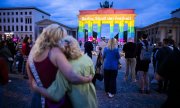
CSD attack in Berlin: what to think, what to do?
Berlin's Christopher Street Day parade was cut short on Saturday evening following an attack. A van driver ploughed into a crowd on the fringes of the festival and then attacked passers-by with what appeared to be a machete. One woman died and 29 people were injured. The suspected 21-year-old perpetrator was a known Islamist. He was shot dead in a police operation on Sunday.
Keep a cool head and sense of proportion
Politiken warns against exaggerating the threat to Europe posed by violent Islamists:
“Islamist terrorist attacks are very rare in Europe. The threat has diminished as a result of the expanded powers and intensive efforts of European security services. These efforts must be maintained and, where necessary, stepped up, but it is important to keep things in proportion. … Terrorist attacks like the one in Berlin aim above all to foment fear, mistrust, anger and even more extremism. The danger this poses must not be underestimated. Europe faces a host of problems and pressing challenges: Russia, Trump, the climate crisis. Islamist terrorism is not really one of them right now. Despite the attack in Berlin.”
Collaboration instead of marginalisation
Avvenire makes the case for cooperation with moderate Muslims:
“Despite our horror and revulsion, we must prevent the attacks from achieving their aim of pitting 'us' against 'them', thereby forcing Muslims into the extremist camp of the enemies of our civilisation. ... The response to violent extremism must, first and foremost, consist of forging alliances with moderate and cooperative Islam. If the religious sphere is dominated by legitimate and influential figures who are able to reach out to young people and educate them in maintaining a harmonious balance between spiritual, ethical and civic values, the scope for radical propaganda will be drastically reduced.”
Blind in one eye
The queer community has downplayed the threat from Islamists for years, taz laments:
“The enemy is on the right, almost all activists would say – for the most part correctly – pointing to violent attacks mainly in the east of Germany, to Pride parades that come under attack, and to an unreliable police force. They are not wrong, however, this accusation fails to mention that Islamist attackers specifically target gay men, lesbians and trans people – who in their eyes embody everything that corrupts the world. ... Many on today's left are blind to this fact and will remain so if they refuse to acknowledge that these threats exist right here among us.”
Opposition to Islamism remains weak in Germany
In a Telegram post republished by Echo, Alex Yusupov, a political scientist at the Friedrich-Ebert-Stiftung, complains of blindness to Islamist threats across the German political spectrum:
“In Germany, both the left and the liberals lack the ability and the willingness to call out Islamism as one of the key threats to public safety. When it comes to far-right violence, we all know which side we are on, and this sense of solidarity mobilises society time after time. In the case of Islamists, however, there is a lack of clarity. There will be no 'demonstrations against Islamism' because, ultimately, the majority of people do not regard this issue as 'their own'.”
Berlin still a divided city
Svenska Dagbladet outlines the moral contrasts in Berlin:
“Berlin remains a divided city to this day. ... Today's dividing line runs between neighbourhoods with progressive values and those where people's lives are restricted in the name of religion and honour. … It is this contrast that most clearly defines the German capital: on the one hand, it is one of the most tolerant places in the world when it comes to lifestyle and choice of partner. On the other hand, it is home to one of the largest Islamist scenes in Europe. ... [The suspected attacker, Abdul] Ballout may have acted alone. But his hatred of the right to love whomever one chooses is shared by many.”
Refuse to be intimidated or divided
El País calls for resistance to violence:
“Should the Islamist background be confirmed, it would be proof that the danger posed by this violent ideology has not disappeared since the mass attacks of the first two decades of the 21st century, from Madrid to Paris. ... In recent years, with the weakening of Islamic State in Syria and Iraq, the threat has mutated. The attacks are no longer complex operations designed to cause mass death and destruction but are carried out by perpetrators acting on their own initiative. ... It is freedom of expression and assembly, as well as equality, that they seek to destroy. ... The only response is to refuse to let them intimidate or divide us. That would be their greatest victory and the defeat of democracy.”
Time to name the threat
The Neue Zürcher Zeitung has had enough of all the pussyfooting:
“In the wake of such acts of terror, Islamic organisations offer at best half-hearted condemnations of the violence. ... There is no willingness to promote tolerance towards sexual minorities. ... Both organised Islam and the German left must at last understand that it is not enough to condemn the deeds: they must name the perpetrators. In the gay community, the truth about who is threatening their freedom and their lives has long been an open secret. Only the official LGBT organisations still act as if the rise of the AfD were the biggest problem. ... Germans have long since realised that there are no quick fixes, let alone absolute security. But they can at least expect politicians to stop spouting platitudes and take decisive action instead.”
Public space can never be completely safe
Die Zeit counters:
“You can never provide full protection for a wild party that takes place across the city like Christopher Street Day, otherwise it would not be a parade but a high security zone. When murderers turn a car into a weapon like in the Berlin Tiergarten and then attack revellers with a machete, a street festival becomes a form of street terror that is very, very difficult to prevent. We have to live with a certain vulnerability, just as the French have demonstrated after the attacks on the Charlie Hebdo offices and the Bataclan nightclub in Paris, and the pedestrians on the promenade in Nice.”
Convicted Islamists belong in prison
Novinky.cz comments:
“Banning Islam would be a mistake, as it would rob us of a part of democracy – namely freedom of religion. However, Islamic fundamentalism, which seeks to overthrow our system, and the terrorism associated with it cannot be tolerated and must be resolutely combated. ... Muslim radicals are trying to impose their way of life on others. ... The incident also highlights our naivety. Convicted criminals with proven links to Islamic radicals should not be released from prison. Attempting to deradicalise young fundamentalists on a therapist's couch is a waste of resources. They won't abandon their faith or convictions, and can even reinforce them online or by listening to radical sermons in mosques.”
No one should be surprised
The attack in Berlin confirms the views of those who have long warned of the threat posed by radical Islam in Europe, writes columnist Jonathan Sacerdoti in The Spectator:
“Some of us have tried warning about this for some years now. We tend to get dismissed as 'racist', even though Islamist terrorists come from a variety of different ethnic backgrounds. We are smeared as 'divisive', even though we are mostly very inclusive people who are united with other lovers of freedom in our opposition to those who seek to divide (and kill) non-believers in Islam. They sometimes call us 'alarmist', even though we have plenty of frequent examples to draw on for our plaintive and urgent warnings.”
Playing into the hands of the AfD
The Handelsblatt fears that this will generate new momentum for one party in particular:
“Three factors play right into the AfD's hands. According to the police, the suspect is affiliated with the Islamist scene. ... Secondly, the suspect was only recently released from a youth detention centre. This represents precisely the kind of state failure that the AfD has been denouncing for years. And thirdly, calls for a ban on the AfD started circulating in the hours following the attack. Yet the fact that the perpetrator apparently comes not from the far-right but from Islamist circles reinforces the AfD's eternal victim narrative. ... The party hasn't had to lift a finger. ... It has been handed the advantage on a plate.”