
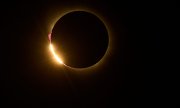
What does the solar eclipse tell us?
For the first time in 20 years, Europe witnessed a solar eclipse which was total in some parts of the continent yesterday. Equipped with special glasses, cameras, and picnic baskets, millions of people gathered to experience this celestial spectacle. Commentators in Europe's media take an unusually philosophical view of the event.
An unmissable spectacle
Solar eclipses no longer hold the same significance for us as they did for our ancestors, laments theologian Vito Mancuso in La Stampa:
“For the people of antiquity, an eclipse could be a truly terrifying event, because for them the sun was a manifestation of the divine, and when it darkened, this heralded an upheaval of the world order. ... None of us, however, felt any fear yesterday. We all knew exactly what was happening, when and why, and so we turned this phenomenon into what our society seems to turn everything into nowadays: a spectacle. ... The eclipse became an event not to be missed and, above all, one that we had to show others we hadn't missed.”
Superstition reawakened
A darkened sun makes people superstitious once more, Corriere della Sera notes:
“For 58 seconds, the sun was black. The colours vanished, the birds suddenly fell silent. ... A different darkness to that of the night. Not because of the sudden drop in temperature but because of the suspicion that creeps into our minds. ... What if time were to stand still? Fears and superstitions are easier to understand in the wake of a solar eclipse. ... Our mobile phones show the exact start and end times, everything is rational and all worked out in advance. And yet, when the sun was reduced to just a narrow strip, we made as much noise as the people of antiquity. To drive away the dragon, the evil god who was devouring the sun.”
An enjoyable apocalypse
For Delfi, the shiver that runs down one's spine at the sight of the sun darkening is refreshing:
“In days gone by, the sun vanishing in the middle of the day gave rise to fears that the gods were angry or that the world was coming to an end. Today, a solar eclipse is one of the few events with an apocalyptic feel to it in which we know with absolute certainty that the world is not coming to an end. War is spreading. The climate is warming. Artificial intelligence is taking our jobs. Democracy is faltering. The economy is struggling. Today, however, the moon passes in front of the sun. It gets dark. Then after a while the sun reappears. A rather enjoyable apocalypse, for a change.”
The moment of truth
Solar eclipses are important reality checks, astrophysicist Miho Janvier explains in Le Monde:
“The total solar eclipse on 12 August represents a test for our scientific community. While there are models based on data from our space probes that enable us to predict the expected shape of the solar corona, the day itself is the moment of truth. By comparing these predictions with the insights provided by the few minutes of darkness during the total solar eclipse, we are also testing the state of our knowledge – in particular what goes into our models – and our ability to predict the state of our sun and, consequently, its influence on our space environment.”