
Canada and the EU: a perfect match?
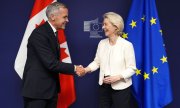
EU Commission President Ursula von der Leyen has announced in the European Parliament in Strasbourg that she wants to bring the EU's relations with Canada "to the highest level possible". In the presence of Canadian Prime Minister Mark Carney she stated that she wanted to open the door for Canada "to be the first associate member of the EU". While commentators are clear on the motives behind the plan, some puzzle over the details.
A strong geopolitical statement
The Irish Times is delighted:
“Canada has shown a willingness to stand up robustly to trade bullying, not to mention threats of annexation, by US president Donald Trump. And Carney has spoken of the need for middle-ranking states to band together as a counterbalance to pressure from hegemons. Von der Leyen's offer was a strong statement of solidarity and a renewed commitment to shared values that will no doubt annoy Trump. The novel concept of associate membership could also provide a useful mechanism for closer, semi-detached links short of membership for other states like the UK, Norway or Iceland.”
Go a step further
The new partnership policy needs to be taken a step further, columnist Pierre Haski urges on France Inter:
“Ten EU member states, including France, still haven't ratified the trade agreement signed with Canada ten years ago! But the context has changed. In Trump's world, countries that used to have privileged relations with the US must reinvent themselves or risk becoming vassals. ... This alliance of middle powers only makes sense if it is extended to include major countries of the Global South. Europe, which is so often divided and powerless, has an opportunity here to set a common goal and find its place in the new world order. An opportunity not to be missed.”
Different to Switzerland
The timing of this rapprochement is no coincidence, notes Corriere del Ticino:
“The EU's opening up to Canada comes at a time of fierce disputes between Ottawa and Washington, with tariffs and retaliatory tariffs being imposed on numerous products. ... The tensions between the two countries have therefore prompted Ottawa to seek closer economic and security ties with Europe. Carney has spoken of forming a 'unique alliance' with the EU ... Not membership, but an entirely new status. This also differs from Switzerland's relations with the EU, which are governed by a long series of bilateral agreements covering a wide range of areas, from the movement of goods to free movement of persons.”
Good idea with a few hurdles to overcome
Although the initiative makes sense, putting it into practice will be no easy task, La Repubblica points out:
“A new 'transatlantic' alliance to stand up to Russia, challenge China on trade and brush aside the outbursts of Donald Trump, who is already threatening 'very high tariffs' on European goods in response. Ursula von der Leyen's initiative in favour of an 'association' between Canada and the EU is the first of its kind, and has groundbreaking geostrategic significance. Its aim is clear: to identify new partners to tackle the uncertainties of this new era. Its implementation, however, still needs to be thoroughly examined. And it will require a 'creative' interpretation of the treaties to make this possible.”
Empty rhetoric
Von der Leyen should have exercised a little more restraint, Tages-Anzeiger criticises:
“Canada, von der Leyen announced with great – though sadly misplaced – pathos, should become the EU's first 'associate member', linked to Europe in an 'Alliance for the Future'. With all due respect, this is nothing but empty rhetoric. There is no such thing as 'associate member' status in the EU. ... So what does she mean? And what about an 'alliance for the future'? Goodness me. In the end, all that remains is von der Leyen's promise to strive to 'bring the relationship with Canada to the highest level possible'. That's all well and good. But what is actually possible? And what if that isn't very much? When you've got nothing to say, there's always the option of saying nothing.”