
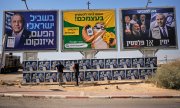
Israeli election: stalemate in the Knesset?
With all the votes counted in Israel's general election, it is now clear that neither of the two major blocs has secured a sufficient majority to form a government: Benjamin Netanyahu's Likud party and its allies won 53 seats in the Knesset, while the electoral bloc led by his challenger, Gadi Eisenkot secured 48. Arab parties won 19 of the 120 seats.
Intimidation tactics worked
Political scientist Abbas Gallyamov explains in a Telegram post republished by Echo why Likud performed better than expected:
“The prime minister's campaign tactic of intimidating Israelis by using Arabs as bogeymen has worked. The slogan 'The Right or Palestine' became Likud's official rallying cry. And although none of the prime minister's critics had actually called for the establishment of a Palestinian state, he persistently placed the issue at the centre of the agenda and argued that as soon as the opposition came to power it would reveal its true pro-Palestinian colours. ... In short: Netanyahu convinced the country that he was the only guarantee that no independent Palestine would emerge alongside Israel.”
Arab votes must count
El Periódico de Catalunya argues in favour of Arab forces joining the government:
“The most significant outcome is the surge in votes for the Arab parties. ... The opposition can only force Netanyahu out of office if it reconsiders its refusal to negotiate with them. ... It now depends on whether the opposition continues to push for a purely Zionist government – which, despite the differences between Netanyahu and Eisenkot would not represent a fundamental break with Israeli security doctrine, or whether it recognises the Arab parties as legitimate negotiating partners in order to be able to govern. ... The elections have shown that excluding a section of the voting populace can be incompatible with forming a stable parliamentary majority.”
Democracy intact despite Netanyahu's arrogance
Israel remains a free country notwithstanding Netanyahu's authoritarian tendencies, writes Rzeczpospolita:
“He compares himself to biblical kings because he has been in power longer than any other prime minister in Israel's modern history. And because he sees himself in the same league as the greatest, Netanyahu takes more liberties than befits a head of state in a democracy. Yet despite this, the Israelis have proved that they are a democratic nation. That elections are held there and that, despite interference from the US, the opposition has a chance to take up the fight for change.”
PM not out of the running yet
NRC sees Israel facing an uncertain political future:
“Netanyahu has suffered a setback but is not yet out of the running. ... Given the deadlock over cooperation with the Arab parties, Israel may be heading for a general election in 2027 – a scenario in which Netanyahu would remain in office as interim prime minister. For Israel's longest-serving leader and his supporters, this is of course not a bad outcome. But for Israelis who yearn for domestic political change, the memory of the marathon of five elections between 2019 and 2022 is still fresh.”
Partners needed
Polityka sees the Arab parties in the role of kingmaker:
“History shows that the politician tasked with forming a government will succeed in doing so. ... Everything indicates that without the support of the Arab parties, none of the candidates will be able to form a government. Eisenkot potentially has the better chances, even though hypothetical coalition partners announced ahead of the elections that they would not enter into an alliance with the Arabs. The Arab parties could play their part in forming a minority or even a majority government if the main opponent of this solution, Avigdor Lieberman, were to withdraw into the opposition.”
Eisenkot has a chance
A coalition led by Eisenkot would be possible, says La Stampa:
“President Isaac Herzog must decide who has the best chances of forming a government, while taking into account two major currents of public opinion: those who are horrified by the massacre of 7 October, and those – mostly from the Arab minority – who are equally shocked by the destruction of the Gaza Strip. Reconciling these two sides will be Eisenkot's task, should he be given the mandate to form a minority government. The alternative would be to hold another election in three months' time.”
Change depends on certain ministers losing their posts
On news website Spotmedia, journalist Irina Olteanu sees a fundamental change of direction within reach:
“A government that is not dependent on politicians like [Minister for National Security Itamar] Ben Gvir and [Finance Minister Bezalel] Smotrich could take more decisive action against settler violence. It would refrain from encouraging the emigration of Palestinians and the disintegration of the Palestinian Authority. Such a government would be more open to initiatives from the US and regional actors on Gaza and other issues. However, it would also inherit the same unresolved questions how to disarm Hamas, who will rebuild Gaza, and who will restore order and respect for the law in the West Bank.”
No majority for Netanyahu’s hysteria
Die Zeit sees a chance for reason and level-headedness to prevail once more:
“For an end to the never-ending drama and hysteria that Netanyahu embodies. In the final phase of his campaign, the prime minister circulated AI-generated images of a mushroom cloud over Tel Aviv. His message: it's either me or the apocalypse. This excessive behaviour, this tendency to throw all caution to the wind can only harm Israel, as it would any country. Benjamin Netanyahu has still been able to mobilise plenty of support for his doomsday rhetoric. But not a majority.”