
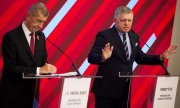
Fico accuses Merz of blackmail over Ukraine aid
Slovak Prime Minister Robert Fico has accused German Chancellor Friedrich Merz of using "blackmail" in his attempts to convince Slovakia to provide further financial support for Ukraine. Merz has demanded that all EU countries without exception make a contribution, and hinted that otherwise they may have problems securing funding from the EU budget. The Slovak government has refused to provide further military aid to Ukraine.
The chancellor is right
Der Spiegel backs Merz's stance:
“This is not even primarily about German interests or a stubborn ego trip, but about the security of Europe. It is not only the right-wing populists from Eastern Europe with close ties to Putin who would like other countries to foot the bill for their security. In France, two presidential candidates who also question aid to Ukraine are leading in the polls: right-wing populist Marine Le Pen and left-wing populist Jean-Luc Mélenchon. Merz's approach of clarifying support for Ukraine through the EU's multiannual financial framework is therefore a shrewd move towards depriving the populists of the possibility to throw a spanner in the works.”
Slovaks' security also at stake
Denník Postoj reminds Prime Minister Fico what this is really about:
“Amid all the disputes over Merz's tactics: Is Ukraine's survival important for our security? If the Ukrainian state were to collapse and and be taken over by Russia, we would face an enormous security, humanitarian and economic problem directly on our eastern border. And it is highly likely that the costs would far exceed what we are currently paying towards the financial aid for Ukraine. Avoiding such a scenario is in the interests of Germany, Slovakia and Europe as a whole. Even setting aside the moral obligation to help a country under attack, this is the crux of the entire discussion.”
A veto would be an own goal
Merz has no interest in exercising a veto, analyst Tamás Lattmann writes on Facebook:
“Chancellor Merz's threat could be seen as just bluffing. ... It sounds intimidating, but the prospect of the European Union being left without an approved seven-year budget is no more genuine than when Viktor Orbán brandished the same whip. What's more, by imposing a veto Chancellor Merz would be putting Germany's own interests at risk, because if Germany were to veto the seven-year budget, the very targets he himself has set would not be met. ... The extent to which this strategy can succeed depends on the other players. As a rule, such a strategy is not very successful, and this is what we should expect.”
PM grossly overestimating his power
Sme rakes Fico over the coals:
“One can criticise Merz's position peacefully, legitimately and decently, but anyone who swears by sovereignty should respect the fact that not just Slovakia but also Germany is a sovereign state. Germany is not subordinate to Slovakia. It is not its debtor, vassal or subject, and nor is it obliged to pay tribute to it. If Fico sees things differently, he is grossly overestimating his power. Merz simply takes the view that a redistribution mechanism as unique as that in the EU requires solidarity, shared values and a consensus on fundamental interests. And he regards the protection of the European security architecture through support for Ukraine as one of those fundamental interests.”
Slovakia must make a clear commitment
Aktuality.sk also criticises:
“We are facing a strategic choice. Is it in our primary national interest to have a truly sovereign, democratic and stable Ukraine with the prospect of joining the EU on our eastern border? And to ensure, together with the European Union, Canada and other partners, that it does not lose its independence, national identity and the chance of a just peace with credible guarantees? Or should we seek privileged relations with Putin's Russia in the hope of securing cheaper oil and gas and its supposed gratitude? ... We cannot waver endlessly between these two security options. Duality is no longer pragmatism here, but political schizophrenia and strategic blindness on the part of the Fico government.”