
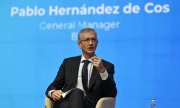
Spanish economist to succeed Lagarde at the ECB
The European Council nominated Spanish economist Pablo Hernández de Cos to succeed ECB President Christine Lagarde on Thursday. The 55-year-old was head of Spain's central bank from 2018 to 2024 and is currently at the helm of the Bank for International Settlements. Commentators discuss implications for the ECB's future course.
Analytical, reformist, independent
El Mundo highlights the qualities of the new ECB president:
“As the head of the Spanish central bank, Hernández de Cos defended its independence even when his criticism caused unease within the government. ... His analytical rigour and proposals for reform were decisive factors in his appointment. These qualities are indispensable for leading the ECB in times of rising inflation and with the risk of a debt crisis in countries such as France. The ECB's interest rate decisions will affect millions of families and businesses. Maintaining price stability and market confidence requires independence from governments, as well as the ability to create consensus. Hernández de Cos has earned this authority over the course of his career.”
Proof of the progress our country has made
More and more Spaniards are playing a part in decision-making within the EU, El País notes with satisfaction:
“The decision is a mark of respect for Spain because, together with Nadia Calviño at the European Investment Bank and Teresa Ribera as vice-president of the European Commission, it consolidates Spain's presence in the European institutions. The appointment also testifies to the progress of a country that has gone from being at the epicentre of the financial crisis in 2012 to leading the regulatory and supervisory body of the European banking system. None of this would have been possible without the government's determined commitment and the consensus reached with the opposition – in these times of polarisation and in the run-up to elections, this is no small feat.”
Do more for the energy transition
The ECB needs to adopt a more nuanced approach when setting interest rates under its new leadership, economist Jézabel Couppey-Soubeyran urges in Le Monde:
“By raising key interest rates, the ECB is making the financing of the energy transition more expensive - and therefore more difficult - rather than easing it. Differentiated refinancing rates could offer a way out of this paradox: lower rates for banks financing the transition to renewables and higher rates for those supporting fossil fuel activities. The ECB proved it is capable of doing this during the Covid-19 pandemic. Through its targeted refinancing operations, it granted bank interest rates as low as minus one percent on the sole condition that they did not reduce their lending to the economy.”
Please stay on course!
Germany has every reason to be satisfied, the Frankfurter Allgemeine Zeitung comments:
“The assumption that a central bank governor from Spain will automatically favour a more relaxed monetary policy does not do Hernandez de Cos justice. In Spain, he was appointed by a conservative government as an independent technocrat. On the spectrum between doves (advocates of a loose monetary policy), and hawks (proponents of a tight monetary policy), he is no doubt similar to his predecessor, Christine Lagarde. ... What will be particularly important for the ECB in the coming years is defending its objective of ensuring price stability against calls from indebted countries, first and foremost France, to come to their aid. ... So please stay on course!”
Second most important post goes to a German
La Repubblica explains what Berlin stands to gain from this appointment:
“In exchange for Germany yet again foregoing a post to which it was entitled in the perpetual balancing act between North and South, and for agreeing to the third consecutive representative from the Mediterranean countries (following Mario Draghi and Christine Lagarde) being appointed, Friedrich Merz wanted to secure the chief economist post. This is the second most important after that of president, and will now go to a German economist who teaches at Princeton: Markus Brunnermeier. And it will be he who, with his economic reports presented to the Executive Board every 40 days, will provide the impetus for monetary policy decisions.”